




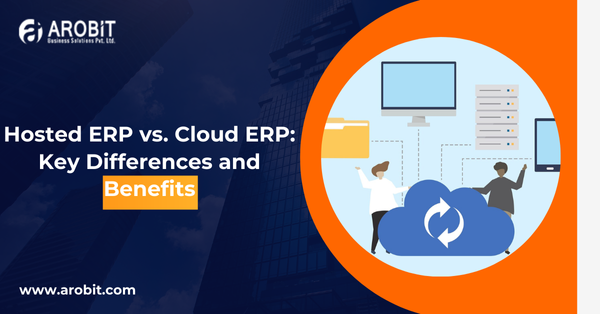
Enterprise Resource Planning (ERP) systems are essential tools for modern businesses, integrating processes like accounting, inventory management, and human resources into a unified platform. With the global ERP market projected to grow at a CAGR of 8.2% from 2023 to 2030, businesses are increasingly looking for efficient and scalable ERP solutions to stay competitive. This has fueled the shift from traditional on-premise ERP systems to hosted ERP systems and cloud ERP solutions. Understanding the differences between these two models is crucial for making informed decisions, especially when considering ERP vs. Cloud ERP.
Understanding Hosted ERP
Definition and Characteristics
Hosted ERP is a class of ERP system deployment where traditional installed ERP packages reside on third-party servers. It enables remote access through the internet but still retains most, if not all, of the limitations of traditional systems. Vendors may also refer to the hosted ERP as "cloud" solutions, without either the real-time upgradability of modern Cloud ERP. This is somewhat termed "cloud washing"—simply rebranding legacy hosted ERP as cloud solutions with none of the genuine cloud contrived for scalability or seamless upgrades.
Concept of "Cloud Washing"
Some vendors engage in cloud washing—rebranding legacy hosted ERP as cloud solutions without delivering genuine cloud benefits like scalability or seamless updates. Companies that adopt these systems will face
- Limited scalability owing to static infrastructure.
- Complex and costly upgrades.
- Less flexibility compared to a true ERP cloud solution.
Possible Pitfalls
Although hosted ERP appeals to businesses hesitant to adopt fully integrated cloud-based ERP systems, it might lead to the following:
- Mounting costs due to maintenance and manual upgrades.
- Limited flexibility towards the business changes.
Defining True Cloud ERP
True Cloud ERP is an implementation of a system that meets cloud computing guidelines set by the U.S. National Institute of Standards and Technology (NIST). The core service components include:
Resource Pooling: Multiple clients share the same infrastructure in a multitenant architecture.
- On-Demand Self Service: Provisioning of resources is done without human intervention.
- Rapid Elasticity: Elastic scaling in response to demand.
- Broad Network Access: Access initiated from different devices based on standard protocols.
- Measured Service: Transparent usage-based pricing models.
These features render Cloud ERP too flexible, cost-effective, and efficient when compared to hosted solutions, transforming the ERP experiences into an optimal shopping experience for the management of their cloud computing.
Comparing Hosted ERP and Cloud ERP
Key Characteristics Comparison
|
Feature |
Cloud ERP |
Hosted ERP |
|
Resource Pooling |
Fully utilizes shared resources |
Often uses dedicated resources |
|
Self-Service |
Supports on-demand provisioning |
Requires vendor involvement |
|
Scalability |
Rapidly scalable |
Limited scalability |
|
Network Access |
Accessible across devices |
May have compatibility issues |
|
Measured Service |
Usage-based pricing |
Fixed pricing |
Key Benefits Comparison
Reduced IT Infrastructure
- Both systems reduce IT requirements, but Cloud ERP eliminates the need for on-premise hardware, saving costs on physical servers and related maintenance.
Rapid Implementation
- Cloud ERP provides faster deployment than hosted systems, enabling a company to be up, live, and in business with little downtime or delays.
Flexibility/Agility
- Cloud ERP is uniquely able to meet the changing business needs relatively efficiently, making it perfect for businesses that wish to pivot or scale quickly.
Scalability
- Cloud platforms adapt quickly to meet growing user demands but often rely on manual, time-consuming configurations for hosted systems.
Ease of Upgrades
- Streamlines the process of upgrading; on Cloud, upgrades are automatic; on hosted, they necessitate manual input, increasing complexity.
Cost Efficient
- Over time, the Cloud ERP is less expensive, allowing for lower maintenance, energy, and support costs than the hosted alternative.
Importance of Differentiating Between Hosted and Cloud ERP
Functionality
Cloud ERP comes with contemporary capabilities, offering applications such as real-time analytics and AI integration, while hosting often provides out-of-date functionality.
Ease of Upgrades
Cloud ERP allows automatic updates with zero downtime. Hosted solutions usually require planned upgrades, which affect their regular running time and incur extra costs.
Customization and Integration
Cloud ERP allows simple integration with other cloud services, while hosted ERP might falter because of a customization that blocks further upgrades.
Compliance Requirements
Cloud services often adhere to strict industry standards, GDPR included, implementing substantial compliance measures. In contrast, hosted ERPs rely on the capabilities provided by their hosting provider, which may differ widely.
Total Cost of Ownership (TCO) Considerations
The TCO of Cloud ERP has various factors in favor of it against the hosted-solution alternatives.'
- Cost of ownership: Reduced up-front investment necessitating no expensive hardware and infrastructure setup.
- Less effort on maintenance: In the case of Cloud ERP, the updates and security fixes are all handled by the provider.
- Competition on pricing: Subscription-based models lead to streamlined budgetary considerations.
Although these are cost-effective alternatives for the here and now, in the long term, hosted ERPs can considerably outweigh the cost.
Why India is Emerging as an ERP Development Hub
India is a leader among the countries with a diversified IT industry, generally providing quality and affordable software services, including cloud and hosted ERPs. Leading Indian ERP software developers can provide:
- Solutions that are customizable as per industry requirements.
- Sophistication in the traditional hosting followed by the modern cloud technology.
- Most affordable services owing to the huge IT industry in India.
Top Indian firms that are working on ERP include:
- Leading-edge SaaS-based ERP startups.
- Established behemoths providing end-to-end enterprise solutions.
By joining hands with other reputed ERP software development companies in India, one gets the chance to not only work with innovative technologies but also reduce costs. This association can navigate through the complex process of hosting ERP software to assist an organization in migrating to a particular cloud-based solution.
Conclusion
The discussion on Hosted ERP versus Cloud ERP presents a tale of functionality, scalability, and sustained value properties. Whereas hosted ERP solutions may appear to be a transition for businesses wary of full cloud adoption, the true cloud ERP system offers unprecedented flexibility, integrated cost-efficiency, and future-readiness. With that, as companies today are putting productivity first in this very competitive market, the wise move will be an investment in a true Cloud ERP system. One that will promote long-term growth and operational excellence when viewed against cloud ERP vs. on-premise ERP scenarios.


![How to Develop AI Software [Step-by-Step Guide]](https://arobit.com/blog/media/blog/1738663632xkapwzjegx.png)

Comments
No comments yet. Be the first to share your thoughts!