




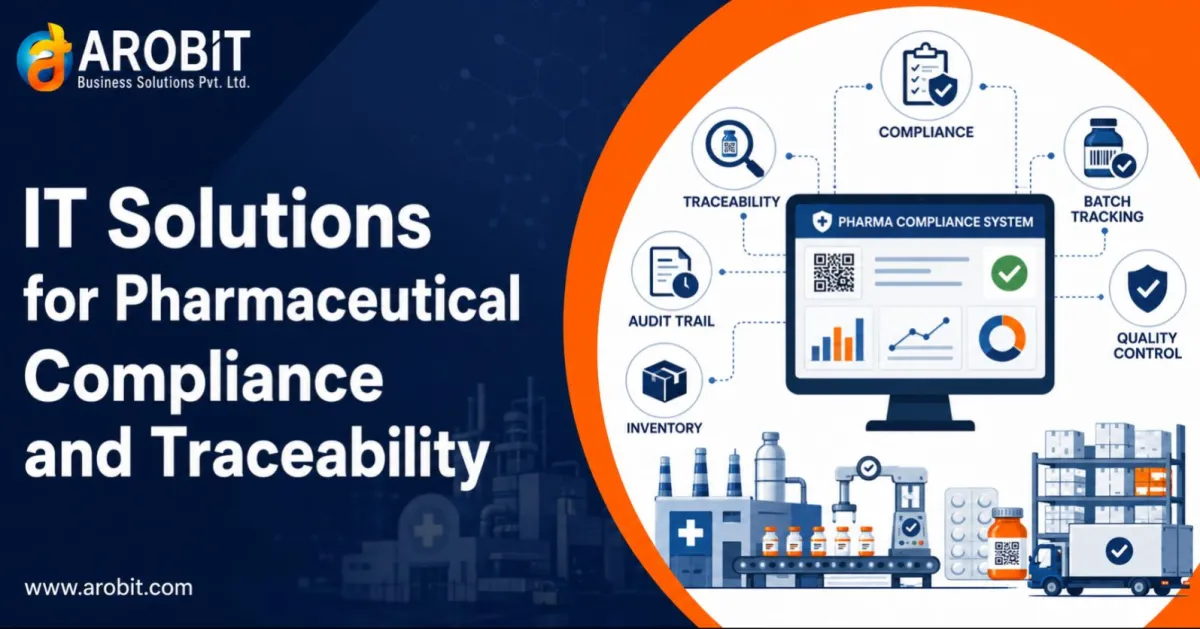
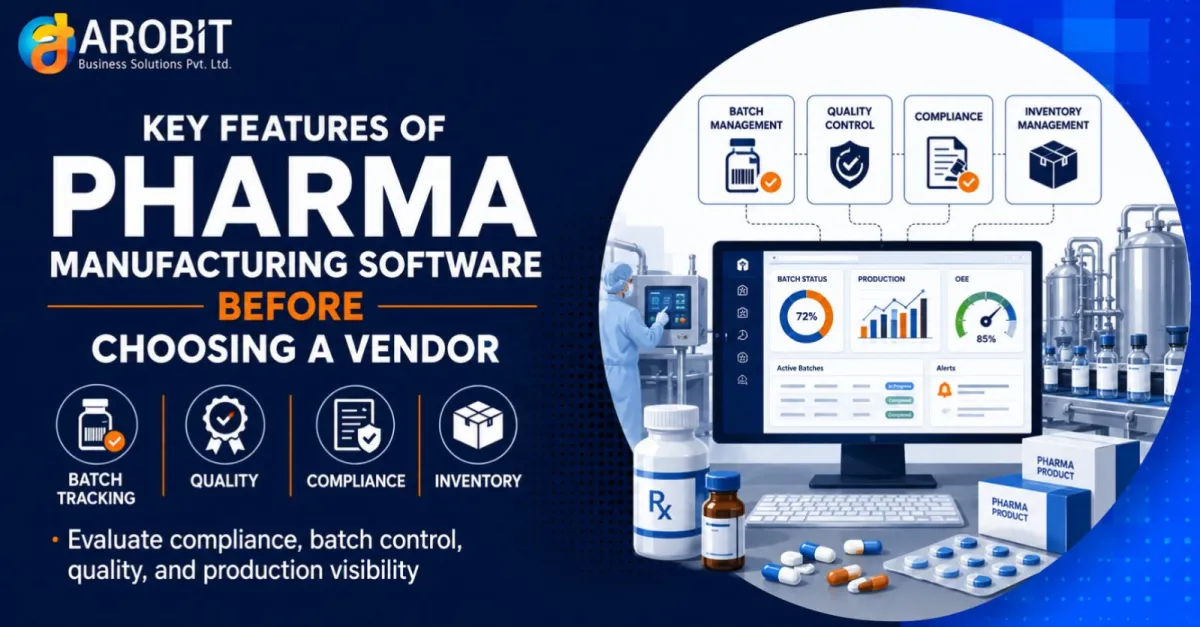
Pharmaceutical manufacturing depends on consistent processes, accurate documentation, and complete product traceability. Every batch must be manufactured according to approved procedures, quality standards must be maintained throughout production, and every material movement should be properly recorded. As manufacturing volumes increase, managing these processes through spreadsheets or disconnected applications becomes increasingly difficult.
Compliance gaps, incomplete batch records, delayed inventory updates, and limited production visibility can affect operational efficiency and make regulatory inspections more challenging. These issues often arise because production, quality assurance, warehouse management, and compliance teams work with information stored across multiple systems.
This is where IT solutions for pharmaceutical compliance and traceability become valuable. Instead of treating production, inventory, quality, and compliance as separate functions, integrated software connects these processes so that information flows consistently across departments.
For pharmaceutical manufacturers, the objective is not simply to digitize records but to create reliable operational workflows that support compliance, improve traceability, and strengthen production control.
Why Compliance and Traceability Require Connected Systems
Pharmaceutical manufacturing is subject to strict regulatory requirements. Businesses must maintain accurate records for raw materials, production activities, quality inspections, packaging, and product distribution.
When information is scattered across multiple applications or maintained manually, manufacturers may encounter challenges such as:
Delayed production reporting
Missing batch documentation
Inventory discrepancies
Limited audit visibility
Manual compliance reporting
Difficulty tracing affected products during recalls
Modern IT solutions for pharmaceutical compliance and traceability address these challenges by connecting operational data across departments. Instead of repeatedly entering the same information into different systems, production teams, quality managers, warehouse personnel, and management work with synchronized business data.
For organizations evaluating IT solutions for pharmaceutical industry, integration is often just as important as individual software features.
Improving Regulatory Compliance Through Integrated Software
Compliance involves more than storing documents. Manufacturing processes should generate complete and verifiable records throughout the product lifecycle.
Reliable pharmaceutical compliance software helps manufacturers manage:
Standard Operating Procedures (SOPs)
Electronic batch records
Change control documentation
Validation records
CAPA documentation
Regulatory reporting
Controlled document versions
Instead of searching through paper files or disconnected folders, authorized personnel can retrieve compliance information from a centralized system.
Effective pharmaceutical software solutions for compliance also improve consistency by ensuring production records, quality documentation, and inventory information remain connected.
This reduces manual effort while making regulatory inspections more efficient.
Strengthening Batch Traceability Across Manufacturing Operations
Batch traceability plays a critical role in pharmaceutical manufacturing.
Every finished product should be traceable back to its raw materials, production stages, quality inspections, packaging process, and distribution history.
Modern pharma traceability software provides visibility throughout the manufacturing lifecycle by recording:
Raw material batches
Manufacturing batches
Equipment usage
Operator activities
Packaging details
Warehouse movements
Product dispatch records
Comprehensive pharma batch traceability software enables manufacturers to investigate quality issues more efficiently.
If a deviation or customer complaint occurs, production teams can identify affected batches quickly instead of manually reviewing production logs.
This capability supports faster investigations while reducing operational disruption.
Better Production Control Through Real-Time Operational Visibility
Production planning depends on accurate information.
Manufacturing managers need visibility into work orders, machine utilization, production progress, inventory availability, and pending quality approvals before making operational decisions.
Well-designed pharma production control software allows manufacturers to monitor production activities through centralized dashboards rather than collecting updates from multiple departments.
Production teams can monitor:
Current manufacturing status
Work-in-progress inventory
Equipment availability
Production schedules
Material consumption
Pending production orders
This level of operational visibility helps reduce scheduling conflicts and supports better coordination between manufacturing, warehouse, procurement, and quality assurance teams.
For manufacturers implementing software solutions for pharmaceutical industry, production control should extend beyond scheduling and provide complete visibility across manufacturing operations.
Integrating Quality Management into Daily Manufacturing
Quality control should be part of every production stage rather than a separate activity performed after manufacturing.
Modern pharma quality management software supports inspections throughout the production lifecycle, including incoming material verification, in-process quality checks, laboratory testing, and finished product approval.
When quality management integrates directly with production records and inventory transactions, manufacturers can identify issues earlier and reduce the likelihood of defective products moving through the manufacturing process.
Businesses seeking IT Solutions for Pharmaceutical Industry often benefit from software that connects quality management with inventory, production planning, compliance documentation, and reporting instead of treating quality as an isolated function.
Maintaining Accountability with Audit Trails
Every activity performed within a pharmaceutical manufacturing system should be recorded automatically. Whether a production supervisor updates a batch record, a quality analyst approves a test result, or a warehouse executive adjusts inventory, the software should capture the complete history of that action.
A reliable pharma audit trail software solution records:
User information
Date and time of each activity
Previous and updated values
System-generated actions
Approval history
Reasons for modifications, where applicable
These records improve accountability while simplifying internal investigations and regulatory inspections. Instead of manually reconstructing events, manufacturers can review a complete history of production and quality-related activities from a single interface.
When evaluating IT solutions for pharmaceutical compliance and traceability, audit trail capabilities should be considered a core requirement rather than an optional feature.
Connecting Departments Through Custom Software
Many pharmaceutical manufacturers use separate applications for production, inventory, quality assurance, procurement, and finance. While each application performs its own function, disconnected systems often lead to duplicate data entry and inconsistent records.
This is where custom software for pharmaceutical companies can provide significant operational value. Software designed around existing manufacturing workflows can connect multiple departments while supporting organization-specific approval processes, reporting requirements, and production practices.
For example, when production completes a manufacturing batch, inventory levels can update automatically, quality teams can receive inspection requests, and warehouse personnel can prepare the batch for storage or dispatch without manually transferring information between systems.
Organizations working with a Pharmaceutical Software Development Company should evaluate whether the solution can be tailored to their production environment instead of requiring major changes to established business processes.
Better Reporting for Faster Decision-Making
Production managers and business leaders need timely information to make informed decisions.
Integrated reporting helps manufacturers monitor key operational indicators such as:
Batch production status
Material consumption
Production efficiency
Inventory availability
Quality inspection results
Pending compliance activities
Equipment utilization
Manufacturing trends
Instead of collecting spreadsheets from different departments, management teams can review centralized dashboards that present current operational information.
These reports help identify production bottlenecks, monitor compliance activities, and support planning for future manufacturing schedules.
For businesses implementing IT solutions for pharmaceutical industry, reporting should provide meaningful operational insights rather than simply displaying large volumes of data.
Choosing the Right Technology Partner
Selecting pharmaceutical software is not only about functionality. Long-term success also depends on the experience and implementation approach of the technology partner.
Before choosing a vendor, pharmaceutical manufacturers should ask:
Does the solution support our production workflow?
Can the software scale as manufacturing volumes increase?
How are compliance updates managed?
What level of customization is available?
Can the system integrate with existing ERP, warehouse, or laboratory applications?
What implementation methodology is followed?
How is post-deployment support handled?
An experienced Pharmaceutical Software Development Company understands that pharmaceutical manufacturing requires more than standard business software. Production processes, compliance requirements, quality management, and traceability should all work together within a unified system.
Conclusion
Maintaining compliance, ensuring product traceability, and controlling pharmaceutical production require accurate information and coordinated business processes. As manufacturing operations expand, disconnected systems and manual record-keeping make these responsibilities increasingly difficult to manage.
Well-designed IT solutions for pharmaceutical compliance and traceability help manufacturers connect production, inventory, quality assurance, and compliance into a single operational workflow. This improves data accuracy, strengthens traceability, supports regulatory requirements, and provides better visibility across manufacturing operations.
Rather than selecting software based only on feature lists, pharmaceutical companies should evaluate how effectively a solution supports their day-to-day processes, compliance obligations, and future operational goals. Software that aligns with real manufacturing requirements can become a valuable foundation for consistent production and informed decision-making.
For organizations looking for IT Solutions for Pharmaceutical Industry, choosing a solution that reflects industry workflows and regulatory expectations can provide long-term operational benefits while supporting business growth.
Frequently Asked Questions
1. What are IT solutions for pharmaceutical compliance and traceability?
IT solutions for pharmaceutical compliance and traceability are software systems that help pharmaceutical manufacturers manage production records, quality processes, inventory, batch traceability, regulatory documentation, and reporting through integrated workflows.
2. Why is batch traceability important in pharmaceutical manufacturing?
Batch traceability enables manufacturers to track products from raw materials to final distribution. It supports product recalls, quality investigations, and regulatory compliance by providing complete production history for every batch.
3. How does pharmaceutical compliance software improve manufacturing operations?
Pharmaceutical compliance software centralizes documentation, manages regulatory records, supports SOPs, tracks change control activities, and helps manufacturers maintain accurate records for inspections and audits.
4. What should companies look for when selecting pharmaceutical software?
Businesses should evaluate compliance management, traceability, production control, inventory management, audit trails, reporting capabilities, scalability, integration options, and the vendor's experience in pharmaceutical manufacturing.
5. Can custom pharmaceutical software integrate with existing ERP systems?
Yes. Custom software for pharmaceutical companies can be developed to integrate with ERP, warehouse management, laboratory information systems, and other enterprise applications, allowing departments to share consistent operational data.




Comments
No comments yet. Be the first to share your thoughts!