




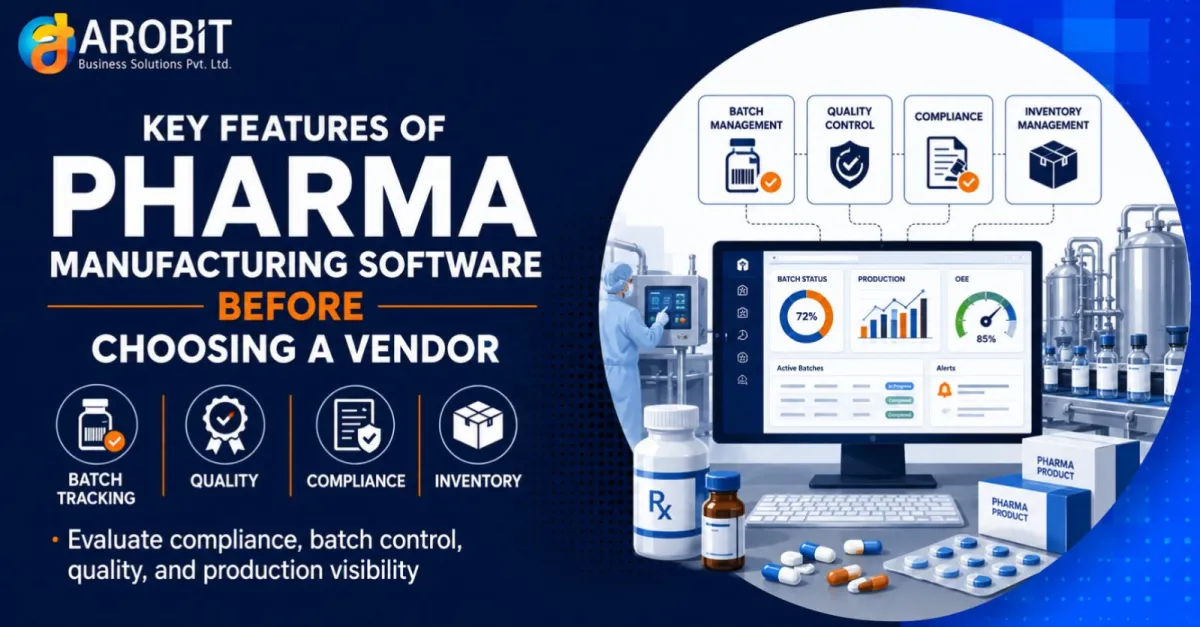
Pharmaceutical manufacturing depends on precision, traceability, and compliance. From managing raw materials and batch production to maintaining quality standards and meeting regulatory requirements, every process generates critical data that must remain accurate and accessible.
Many pharmaceutical companies still rely on disconnected spreadsheets or multiple standalone applications to manage production, inventory, quality control, and compliance. As operations grow, these disconnected systems can lead to inventory discrepancies, delayed production planning, incomplete documentation, and difficulties during regulatory audits.
Selecting software should therefore involve more than comparing product brochures or pricing. Businesses need to evaluate whether the solution supports their manufacturing workflows, regulatory obligations, and future operational requirements.
Understanding the features of pharma manufacturing software before choosing a vendor helps manufacturers invest in a solution that supports efficiency, product quality, and long-term scalability.
Why Software Features Matter More Than Vendor Claims
Every software vendor highlights automation, reporting, and operational improvements. However, pharmaceutical manufacturers should look beyond marketing claims and evaluate whether the application addresses industry-specific challenges.
For example, a manufacturer producing multiple formulations each day requires different capabilities than a company producing specialized medicines in smaller batches. Likewise, organizations operating across multiple manufacturing plants require stronger production visibility than businesses running a single facility.
The right software should improve everyday operations while supporting compliance with pharmaceutical manufacturing standards.
When evaluating pharma manufacturing software features, focus on how each capability contributes to production accuracy, regulatory compliance, inventory visibility, and product quality.
1. Batch Tracking and Complete Product Traceability
Batch traceability is one of the most important features of pharma manufacturing software.
Every manufactured batch should be traceable from raw material procurement to finished product dispatch. The software should record information such as:
Raw material sources
Manufacturing dates
Batch numbers
Processing stages
Packaging details
Distribution records
Comprehensive batch tracking software for pharma manufacturing enables manufacturers to identify affected batches quickly if a quality issue or product recall occurs.
Instead of manually reviewing production records, authorized users can retrieve complete batch histories within minutes, reducing investigation time and improving regulatory response.
2. Production Planning and Process Monitoring
Production planning directly affects manufacturing efficiency.
Without proper scheduling, production teams may experience equipment downtime, raw material shortages, or delayed deliveries.
Reliable pharma production management software should provide visibility into:
Production schedules
Machine utilization
Work orders
Resource allocation
Production progress
Manufacturing bottlenecks
Managers can monitor production status in real time and adjust schedules based on changing demand or operational priorities.
This level of visibility helps reduce production delays while improving coordination between manufacturing, warehouse, procurement, and quality teams.
3. Inventory Management Across Raw Materials and Finished Goods
Inventory accuracy is essential in pharmaceutical manufacturing.
Manufacturers need continuous visibility into raw materials, work-in-progress inventory, packaging materials, and finished products.
Effective pharma inventory management software should support:
Real-time inventory updates
Batch-wise stock tracking
Expiry date monitoring
Warehouse transfers
Stock availability reports
Material consumption tracking
These capabilities reduce stock shortages, minimize excess inventory, and support better production planning.
For organizations seeking IT Solutions for Pharmaceutical Industry, integrated inventory management becomes especially valuable because procurement, production, warehouse, and finance teams can work with consistent inventory information across departments.
4. Quality Control Built Into Manufacturing Workflows
Quality should not be treated as a separate activity performed after production.
Modern pharmaceutical quality control software integrates quality inspections throughout the manufacturing lifecycle.
The software should support:
Incoming material inspections
In-process quality checks
Laboratory testing
Finished product verification
Non-conformance management
Corrective and preventive actions (CAPA)
Embedding quality processes within production workflows helps identify issues earlier rather than after products have been completed.
When reviewing pharmaceutical manufacturing software features, manufacturers should evaluate whether quality control integrates directly with production records, batch documentation, and inventory transactions instead of operating as an isolated module.
5. Compliance Management and Regulatory Documentation
Regulatory compliance is a fundamental requirement in pharmaceutical manufacturing. Software should simplify documentation and record management rather than creating additional administrative work.
A robust pharma compliance management software solution should help organizations manage:
Standard Operating Procedures (SOPs)
Electronic records
Validation documentation
Change control processes
Document version control
Regulatory reporting
Instead of manually searching for records during inspections, authorized users should be able to retrieve complete documentation from a centralized system.
When assessing the features of pharma manufacturing software, verify whether compliance functions are integrated into daily operations instead of existing as separate modules.
6. Audit Trails for Complete Operational Transparency
Every action performed within pharmaceutical software should be traceable.
Whether an employee updates a batch record, modifies inventory quantities, or changes production data, the software should automatically record:
User information
Date and time
Previous values
Updated values
Reason for modification (where applicable)
An effective audit trail software for pharmaceutical industry improves accountability while helping organizations prepare for regulatory inspections and internal audits.
Instead of relying on manual logs, businesses can demonstrate who performed an action and when it occurred.
This capability becomes particularly valuable when investigating production deviations or quality issues.
7. ERP Integration for Connected Manufacturing Operations
Production, procurement, inventory, finance, warehouse management, and quality assurance should not operate independently.
Modern pharmaceutical manufacturers benefit from software that connects these functions into a single operational workflow.
Important pharma ERP software features include:
Procurement integration
Inventory synchronization
Production planning
Purchase order management
Financial reporting
Warehouse coordination
Vendor management
An integrated pharma manufacturing management system reduces duplicate data entry while improving information accuracy across departments.
For organizations planning long-term growth, selecting a Pharmaceutical Software Development Company capable of building software around existing workflows can be more beneficial than adapting business processes to rigid, off-the-shelf applications.
8. Reporting and Business Visibility
Good reporting supports better operational decisions.
Manufacturing managers should not have to combine spreadsheets from multiple departments before understanding production performance.
Instead, the software should provide dashboards and reports covering:
Batch production status
Inventory levels
Material consumption
Production efficiency
Quality trends
Equipment utilization
Compliance status
These reports help management identify bottlenecks, monitor productivity, and plan future manufacturing activities with greater confidence.
Feature Evaluation Checklist Before Choosing a Vendor
Selecting pharmaceutical manufacturing software involves more than comparing feature lists. Consider how well each capability supports your business processes.
Feature | Why It Matters |
Batch Traceability | Supports product recalls and regulatory compliance |
Production Planning | Improves scheduling and resource utilization |
Inventory Management | Prevents stock shortages and excess inventory |
Quality Control | Detects issues during manufacturing instead of after production |
Compliance Management | Simplifies regulatory documentation |
Audit Trails | Maintains accountability and inspection readiness |
ERP Integration | Connects manufacturing with business operations |
Reporting & Dashboards | Supports informed operational decision-making |
Rather than asking whether software includes a feature, ask how that feature supports your manufacturing workflow today and whether it can continue supporting future operational requirements.
Questions to Ask Before Selecting a Vendor
Before making a final decision, manufacturers should discuss the following with potential vendors:
Can the software be customized for our manufacturing workflow?
How are batch records managed?
Does the system support multi-location manufacturing?
How are audit trails maintained?
What compliance standards does the software support?
Can existing ERP or warehouse systems be integrated?
What implementation and post-deployment support is provided?
How easily can reports be customized?
Businesses looking for a Pharmaceutical Software Development Company should also evaluate industry experience, implementation methodology, technical support, and the ability to adapt software as operational requirements evolve.
Similarly, providers offering IT Solutions for Pharmaceutical Industry should demonstrate practical experience with production planning, inventory control, quality management, compliance, and enterprise integration rather than offering only generic ERP functionality.
Conclusion
Choosing pharmaceutical manufacturing software is a long-term operational decision. While many applications offer similar capabilities on paper, the value of the software depends on how effectively those features support manufacturing processes, regulatory compliance, inventory management, and quality assurance.
The most valuable features of pharma manufacturing software are those that improve operational visibility while reducing manual work, maintaining accurate records, and supporting informed decision-making across departments.
Before selecting a vendor, evaluate whether the solution aligns with your production workflows, compliance obligations, and future business growth. A carefully planned software investment can provide a stronger foundation for efficient manufacturing operations and long-term business performance.
Frequently Asked Questions
1. What are the most important features of pharma manufacturing software?
The most important capabilities include batch tracking, production planning, inventory management, quality control, compliance management, audit trails, ERP integration, and reporting dashboards.
2. Why is batch tracking important in pharmaceutical manufacturing?
Batch tracking enables manufacturers to trace products throughout the production lifecycle, making product recalls, quality investigations, and regulatory inspections more efficient.
3. How does pharma inventory management software improve operations?
It provides real-time visibility into raw materials, work-in-progress inventory, and finished goods, helping manufacturers reduce stock shortages and improve production planning.
4. What should manufacturers look for in pharma ERP software?
Key pharma ERP software features include production planning, procurement management, inventory control, financial integration, quality management, reporting, and audit trails.
5. Why is an audit trail important in pharmaceutical software?
Audit trails record every system activity, helping organizations maintain accountability, investigate production issues, and prepare for regulatory inspections.






Comments
No comments yet. Be the first to share your thoughts!