





Automotive component manufacturers operate in an environment where production schedules, quality requirements, and customer delivery commitments are closely connected. Every production order, machine status update, quality inspection, and material movement contributes to overall manufacturing performance. As production volumes increase, relying on spreadsheets or disconnected applications often makes it difficult to maintain accurate production visibility and operational control.
Many manufacturers already use ERP systems for procurement, inventory, finance, and planning. However, ERP software typically does not provide detailed visibility into machine performance, work-in-progress inventory, production execution, or operator activities on the shop floor.
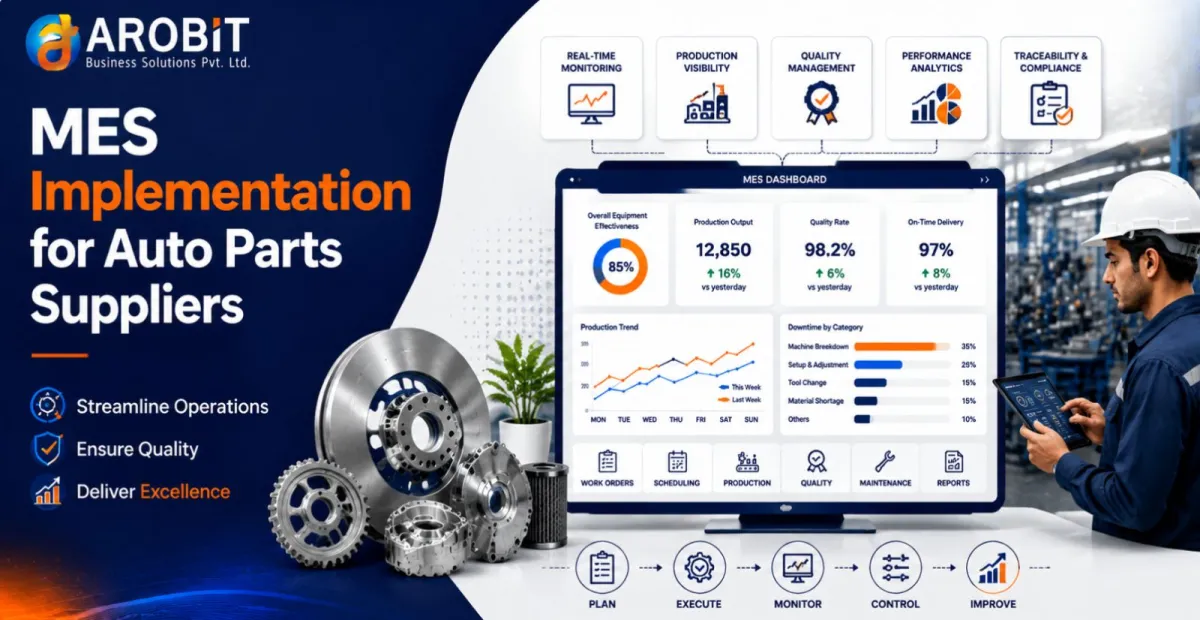
This is where MES implementation for auto parts suppliers becomes valuable. A Manufacturing Execution System (MES) bridges the gap between production planning and shop floor operations by collecting real-time manufacturing data, monitoring production activities, and providing accurate operational visibility throughout the manufacturing process.
For manufacturers planning future technology investments, understanding implementation requirements, software modules, project timelines, and vendor selection criteria is essential before beginning an MES project.
Why MES Matters for Auto Parts Suppliers
Automotive manufacturers are expected to deliver components on time while maintaining strict quality and traceability standards. Delays in production reporting, inaccurate work order status, or limited machine visibility can affect production planning and customer commitments.
A well-designed MES system for auto parts manufacturers helps production teams monitor manufacturing activities as they happen instead of waiting for end-of-shift reports.
Typical operational benefits include:
Improved production visibility
Better machine utilization
Accurate work order tracking
Reduced manual reporting
Faster quality inspections
Better production scheduling
Improved traceability across manufacturing operations
For businesses evaluating Automotive Manufacturing IT Services, MES should be viewed as a production execution platform that complements existing ERP systems rather than replacing them.
Understanding the Scope of MES Implementation
Successful automotive MES implementation involves more than installing software.
Manufacturers should first evaluate existing production workflows, reporting methods, machine connectivity, quality processes, and operational objectives.
A typical implementation includes:
Production process assessment
Requirement gathering
Software configuration
Machine and equipment integration
ERP connectivity
User training
Pilot implementation
Production rollout
Each phase should be planned carefully to minimize production disruption while ensuring the system accurately reflects existing manufacturing operations.
An effective manufacturing execution system for component suppliers should support current production requirements while remaining flexible enough to accommodate future expansion, additional production lines, and changing customer requirements.
Core MES Modules Every Manufacturer Should Evaluate
Not every MES platform offers the same capabilities. Manufacturers should focus on modules that directly support production efficiency and operational visibility.
Important MES modules for automotive suppliers include:
Production Execution
Tracks active production orders, production quantities, machine status, and work-in-progress inventory throughout the manufacturing process.
Work Order Management
Production orders move electronically through manufacturing operations, reducing manual paperwork while improving production visibility.
This functionality also supports production tracking MES for auto parts by providing supervisors with current work order status and production progress.
Machine Monitoring
Captures machine operating status, production cycles, downtime events, and equipment utilization automatically from connected machines.
Quality Management
Integrates inspection activities directly with production workflows by recording inspection results, quality approvals, rejection reasons, and corrective actions.
Traceability
Maintains complete production history by linking raw materials, production batches, operators, machines, and finished components.
For manufacturers considering Custom Automotive Software Development, selecting modular MES architecture allows organizations to implement capabilities gradually based on operational priorities rather than deploying every function simultaneously.
Typical MES Implementation Timeline
The duration of an MES project depends on the number of production lines, machine connectivity requirements, ERP integration, and the complexity of manufacturing operations. Rather than attempting a full-scale rollout, many manufacturers begin with a pilot implementation before expanding to additional production lines or facilities.
A typical MES implementation for auto parts suppliers follows these phases:
Implementation Phase | Typical Activities |
Assessment & Planning | Process study, requirement gathering, production workflow mapping |
Solution Design | MES configuration, module selection, machine connectivity planning |
Integration | ERP connectivity, machine interface setup, production data mapping |
Testing & Training | User acceptance testing, operator training, pilot production |
Go-Live | Production rollout, monitoring, support, and optimization |
Following a phased approach reduces operational disruption while giving production teams time to adapt to new workflows.
Understanding MES Implementation Costs
One of the most common questions manufacturers ask is about the MES cost for auto parts factory operations.
The total investment depends on several factors, including:
Number of production lines
Machine connectivity requirements
Required MES modules
ERP integration complexity
Custom reporting requirements
Number of users
Multiple plant deployments
Post-implementation support
Rather than comparing software licensing costs alone, manufacturers should evaluate the overall implementation scope. A lower initial investment may require additional customization later, while a solution designed around production workflows may deliver greater long-term operational value.
Why ERP Integration Is Essential
Many automotive manufacturers already rely on ERP systems to manage procurement, inventory, finance, warehouse operations, and production planning. However, production execution often takes place separately on the shop floor.
This is where ERP and MES integration for manufacturers becomes essential.
A connected workflow typically follows this sequence:
ERP System
│
Production Orders
│
▼
Manufacturing Execution System
│
Production Execution
Machine Data
Quality Inspection
│
▼
Production Reporting
Inventory Updates
Management Dashboards
By synchronizing production execution with enterprise planning, manufacturers reduce duplicate data entry while improving information accuracy across departments.
An effective manufacturing execution system for component suppliers should exchange production quantities, inventory transactions, work order status, quality records, and machine data with ERP systems in near real time.
Vendor Checklist Before Selecting an MES Solution
Choosing the right software partner is as important as selecting the software itself.
A practical MES vendor checklist for manufacturers should include the following questions:
Does the vendor understand automotive component manufacturing?
Can the software support multiple production lines?
Does it integrate with existing ERP and machine systems?
Are production dashboards customizable?
Can traceability and quality workflows be configured?
Does the solution support future production expansion?
What implementation methodology is followed?
What level of post-deployment support is available?
Manufacturers evaluating MES software for Tier 1 and Tier 2 suppliers should also review previous implementation experience, customer references, scalability, and long-term support capabilities before making a final decision.
Organizations considering Custom Automotive Software Development may benefit from solutions that can be tailored to their production environment instead of adapting their manufacturing processes to standard software workflows.
Conclusion
Implementing an MES is more than a software project—it is an investment in improving production visibility, operational control, and manufacturing efficiency.
A successful MES implementation for auto parts suppliers connects production planning with shop floor execution while providing accurate information about machine performance, work orders, quality inspections, and production progress.
By selecting appropriate MES modules for automotive suppliers, planning implementation carefully, integrating with existing ERP systems, and evaluating vendors against operational requirements, manufacturers can build a production environment that supports consistent quality, better scheduling, and improved manufacturing performance.
For manufacturers exploring Automotive Manufacturing IT Services, choosing an MES solution that aligns with existing workflows and future production goals will provide greater long-term value than focusing solely on software features or implementation cost.
Frequently Asked Questions
1. What is MES implementation for auto parts suppliers?
MES implementation for auto parts suppliers involves deploying a Manufacturing Execution System to manage production execution, machine monitoring, work orders, quality processes, and real-time shop floor visibility.
2. How long does an MES implementation typically take?
Implementation timelines vary depending on plant size, production complexity, ERP integration, machine connectivity, and customization requirements. Many manufacturers begin with a pilot implementation before expanding across the facility.
3. What modules should an automotive MES include?
Important MES modules for automotive suppliers include production execution, work order management, machine monitoring, quality management, traceability, reporting, and production analytics.
4. Why is ERP integration important for an MES?
ERP and MES integration for manufacturers enables production orders, inventory updates, quality records, and work order status to move automatically between enterprise planning and shop floor operations, reducing manual data entry.
5. How should manufacturers choose an MES vendor?
Manufacturers should evaluate industry expertise, implementation methodology, integration capabilities, scalability, customization options, customer support, and experience delivering MES software for Tier 1 and Tier 2 suppliers.







Comments
No comments yet. Be the first to share your thoughts!