




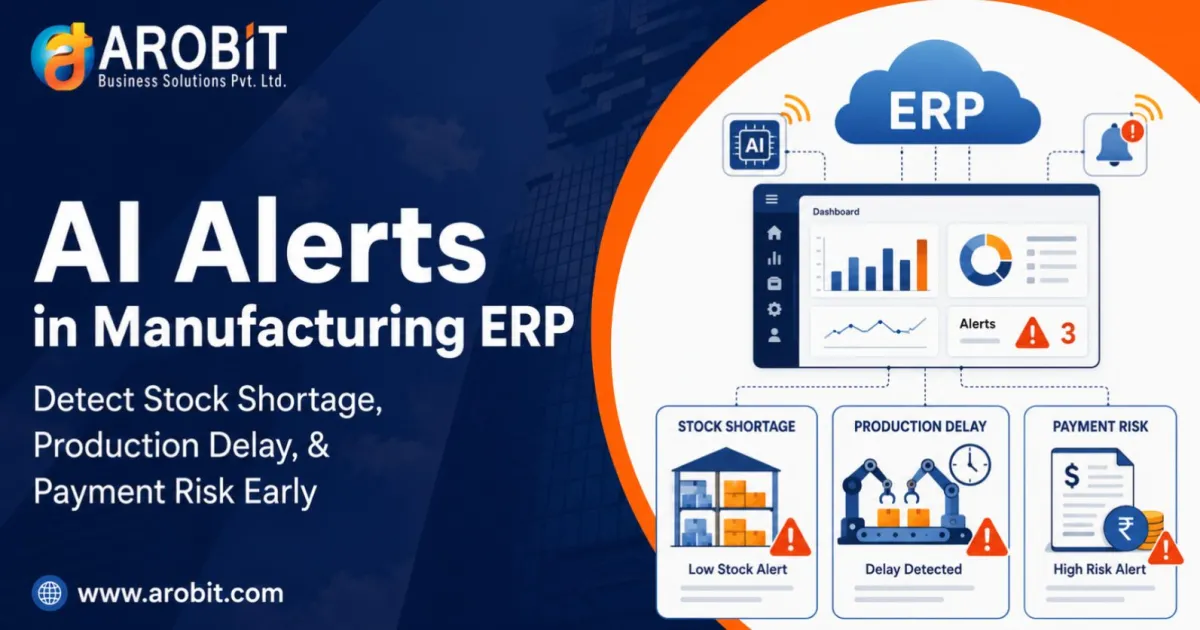
Manufacturing businesses generate large volumes of operational data every day. Inventory transactions, production updates, purchase orders, machine utilization records, quality reports, customer orders, and payment collections all create valuable information that can influence business decisions.
The challenge is not a lack of data. The challenge is identifying problems before they affect production, delivery schedules, customer relationships, or cash flow.
Many manufacturers discover critical issues only after they have already caused operational disruption. A raw material shortage may stop production unexpectedly. A delayed work order may affect dispatch commitments. An overdue customer payment may create cash flow pressure.
This is where AI ERP for manufacturing is changing the way manufacturing businesses manage operations. Instead of relying solely on manual monitoring and periodic reports, AI-powered ERP systems can identify risks early and generate alerts before they become costly problems.
Why Early Detection Matters in Manufacturing
Manufacturing operations depend on hundreds of interconnected activities.
A delay in procurement can affect production schedules. A production bottleneck can impact customer deliveries. A payment delay can influence purchasing decisions and working capital availability.
Many businesses still depend on managers reviewing reports manually at the end of the day or week. By the time issues are discovered, corrective actions often become more expensive and difficult to implement.
Early alerts allow decision-makers to respond proactively rather than reactively.
Instead of asking, "Why did this happen?" management can focus on "How can we prevent it?"
This shift creates measurable improvements in operational efficiency and business performance.
What Are AI Alerts in Manufacturing ERP?
AI alerts are automated notifications generated by an ERP system when data patterns indicate a potential risk or operational issue.
Unlike traditional reports that show historical information, AI systems continuously analyze operational data and identify unusual trends, deviations, or risks.
An AI ERP for manufacturing platform can monitor:
Inventory levels
Production schedules
Purchase orders
Supplier performance
Machine utilization
Quality metrics
Customer payments
Dispatch commitments
When potential problems are detected, the system automatically alerts relevant stakeholders.
This enables faster decision-making and reduces the likelihood of operational disruptions.
Detecting Stock Shortages Before Production Stops
Raw material shortages remain one of the most common causes of manufacturing delays.
Many manufacturers rely on reorder levels or manual inventory reviews to identify replenishment needs. However, these methods often fail to account for changing demand patterns, supplier lead times, or unexpected production requirements.
AI-driven inventory monitoring provides a more dynamic approach.
An AI ERP for manufacturing system can analyze:
Historical consumption trends
Open sales orders
Production schedules
Supplier delivery performance
Seasonal demand fluctuations
Based on this analysis, the system can identify inventory risks before shortages occur.
For example, if production demand is increasing faster than expected, the ERP may recommend earlier procurement activity even when current stock levels appear sufficient.
This helps manufacturers avoid emergency purchases, production interruptions, and missed delivery commitments.
Identifying Production Delays in Real Time
Production schedules rarely go exactly as planned.
Machine downtime, labor shortages, material availability issues, quality rejections, and process bottlenecks can all affect production timelines.
Traditional reporting often identifies delays after production targets have already been missed.
AI-powered monitoring changes this approach.
A modern AI ERP for manufacturing solution continuously compares planned production against actual performance.
The system can identify:
Slower-than-expected production rates
Work order delays
Capacity constraints
Machine utilization issues
Bottlenecks in critical production stages
When deviations occur, alerts can be sent to supervisors, production managers, or business owners.
This visibility enables teams to investigate issues immediately and take corrective action before customer deliveries are affected.
Managing Payment Risk Before Cash Flow Problems Occur
Production efficiency is important, but financial stability is equally critical.
Many manufacturers experience cash flow challenges because customer payment risks are identified too late.
An overdue payment from a major customer can affect procurement planning, vendor payments, and operational flexibility.
AI systems help identify financial risks by analyzing:
Customer payment history
Outstanding receivables
Credit utilization
Invoice aging patterns
Collection performance trends
An AI ERP for manufacturing platform can alert finance teams when payment behavior begins to change.
For example, if a customer who normally pays within 30 days starts showing delays across multiple invoices, the system can flag the risk before outstanding balances become significant.
This allows finance teams to take preventive measures and reduce exposure to payment-related disruptions.
Improving Cross-Department Visibility
Many manufacturing businesses operate with separate systems for production, inventory, procurement, quality, and finance.
As a result, departments often work with incomplete information.
A procurement team may not know about an upcoming production surge. Production managers may not be aware of inventory risks. Finance teams may lack visibility into customer order trends.
AI-powered ERP systems create a unified operational view.
By integrating data across departments, AI alerts help ensure that every team is working with the same information.
This is one reason why organizations increasingly invest in manufacturing IT solutions that connect operational and financial processes within a centralized platform.
Improved visibility reduces communication gaps and supports better coordination across the business.
Key Areas Where AI Alerts Create Value
Inventory Management
AI alerts can identify:
Potential stock shortages
Excess inventory accumulation
Slow-moving inventory
Supplier delivery risks
Production Management
AI monitoring can detect:
Work order delays
Capacity constraints
Machine performance issues
Production bottlenecks
Quality Management
Alerts help identify:
Rising defect rates
Recurring quality issues
Inspection failures
Process deviations
Financial Management
AI analysis can highlight:
Overdue receivables
Credit risks
Payment delays
Cash flow concerns
This visibility helps manufacturers make informed decisions across all critical business functions.
Moving Beyond Traditional ERP Reporting
Traditional ERP systems primarily focus on recording transactions and generating reports.
While these capabilities remain important, they often require managers to manually analyze information and identify issues.
AI introduces a predictive layer to ERP operations.
Instead of waiting for problems to appear in reports, businesses receive alerts based on emerging trends and patterns.
An AI ERP for manufacturing solution helps transform operational data into actionable insights, enabling manufacturers to respond faster and reduce uncertainty.
This capability becomes increasingly valuable as production environments grow more complex and customer expectations continue to rise.
The Business Benefits of AI-Powered ERP Alerts
Manufacturers that implement AI-based alert systems often experience improvements in:
Production continuity
Inventory planning
Delivery performance
Working capital management
Decision-making speed
Resource utilization
Risk management
The ability to detect issues early reduces operational surprises and creates a more predictable manufacturing environment.
Businesses can focus less on firefighting and more on continuous improvement initiatives.
Organizations adopting manufacturing IT solutions with AI capabilities are increasingly using predictive insights to strengthen operational control and support long-term growth.
Conclusion
Manufacturing businesses cannot afford to discover problems after they have already affected production, delivery schedules, or cash flow. Early visibility into operational risks has become a critical advantage in modern manufacturing environments.
AI ERP for manufacturing helps organizations move beyond reactive management by identifying stock shortages, production delays, and payment risks before they escalate into larger business challenges. Through intelligent monitoring and automated alerts, manufacturers gain the ability to make faster, more informed decisions across their operations.
As manufacturers continue to seek greater efficiency and operational visibility, technology partners such as Arobit are helping businesses implement ERP solutions that combine process automation, real-time visibility, and AI-driven intelligence to support smarter manufacturing operations.
FAQs
1. What is AI ERP for manufacturing?
AI ERP for manufacturing is an enterprise resource planning system that uses artificial intelligence to analyze operational data, identify risks, generate alerts, and support better decision-making across production, inventory, quality, and finance functions.
2. How do AI alerts help prevent stock shortages?
AI alerts analyze inventory consumption patterns, production schedules, supplier lead times, and demand trends to identify potential shortages before they affect manufacturing operations.
3. Can AI ERP systems help reduce payment risks?
Yes. AI-powered ERP systems can monitor customer payment behavior, invoice aging, and receivable trends to identify potential payment risks early and help finance teams take proactive action.


Comments
No comments yet. Be the first to share your thoughts!