




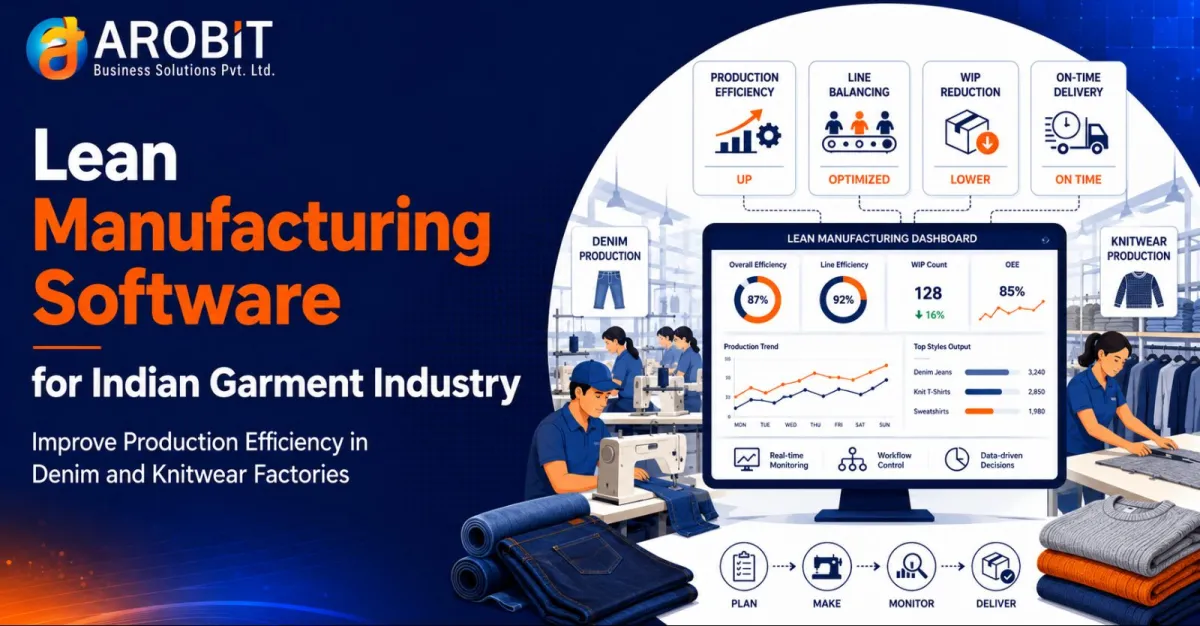
Garment manufacturers today are expected to produce more styles, handle larger order volumes, and deliver within increasingly shorter timelines. Denim and knitwear factories, in particular, must coordinate multiple production stages while managing fluctuating demand, workforce availability, machine capacity, and strict customer deadlines. Even a small disruption in one production line can create delays across the entire manufacturing process.
This is where lean manufacturing software for garment industry in India helps manufacturers gain better control over factory operations. By replacing manual production monitoring with real-time visibility and data-driven planning, businesses can reduce operational waste, improve line efficiency, and make faster production decisions. Whether producing for domestic brands or export markets, lean manufacturing software enables garment factories to improve productivity without compromising quality or delivery commitments.
In this blog, we'll explore how lean manufacturing software for garment industry in India helps denim and knitwear factories improve efficiency while supporting sustainable business growth.
Why Lean Manufacturing Matters in Garment Production
Lean manufacturing focuses on maximizing value while minimizing waste throughout the production process. For garment manufacturers, waste can appear in several forms, including idle machines, excessive work-in-progress, production bottlenecks, material movement, waiting time, and quality defects.
Implementing lean manufacturing software for garment industry in India helps manufacturers identify inefficiencies early and take corrective actions before they affect delivery schedules or customer satisfaction.
Rather than depending on periodic manual reports, production teams gain continuous visibility into factory performance.
Common Production Challenges in Denim and Knitwear Factories
Denim and knitwear manufacturing involve multiple production stages, each requiring careful coordination between departments.
Common operational challenges include:
Uneven production line utilization
Frequent bottlenecks between sewing and finishing
Difficulty monitoring work-in-progress
Delayed production reporting
Machine downtime
Inefficient workforce allocation
Bulk order scheduling conflicts
Inventory shortages affecting production
Without integrated software, these issues often remain unnoticed until delivery timelines are affected.
How Lean Manufacturing Software Improves Factory Operations
Modern lean manufacturing software for garment industry in India provides manufacturers with centralized visibility across the production floor.
Production managers can monitor operations from cutting to packing while tracking machine performance, operator productivity, production targets, and order completion status.
Instead of reacting to problems after production slows down, managers receive timely information that supports faster decision-making.
Key Features to Look for in Lean Manufacturing Software
Real-Time Production Monitoring
Factories benefit significantly from real-time production tracking software garment industry that captures live production data from every department.
Managers can monitor:
Production output
Operator efficiency
Machine utilization
Target achievement
Order completion
Production delays
Real-time visibility enables faster corrective actions and reduces reporting delays.
Work-in-Progress Tracking
An effective WIP tracking software for garment manufacturing helps supervisors monitor unfinished goods as they move through different production stages.
This allows businesses to:
Identify production bottlenecks
Reduce unnecessary inventory accumulation
Improve workflow visibility
Maintain balanced production across departments
Better WIP management also supports faster order completion.
Line Balancing
Maintaining balanced production lines is essential for maximizing factory output.
Using line balancing software for garment industry, manufacturers can allocate operators and machines based on workload, production targets, and available capacity.
Balanced production lines help reduce waiting time while improving productivity.
Improving Production Efficiency in Denim Factories
Denim manufacturing involves specialized operations such as washing, finishing, distressing, quality inspection, and packing.
A dedicated production efficiency software for denim factories in India helps manufacturers coordinate these activities more effectively.
The software provides visibility into production schedules, machine availability, and processing timelines, allowing production managers to reduce delays and improve throughput.
Manufacturers can also use denim garment manufacturing software in India to monitor order progress across multiple production batches while ensuring better coordination between departments.
Supporting Knitwear Manufacturing
Knitwear production often requires quick style changes, flexible scheduling, and efficient workforce planning.
A reliable knitwear factory production management software helps manufacturers manage production calendars, monitor knitting operations, schedule sewing lines, and coordinate finishing processes.
Production planners can quickly adjust schedules when customer priorities change without disrupting the overall production workflow.
Enhancing Overall Production Efficiency
Factories aiming to improve productivity should consider software for improving production efficiency in garment factories that integrates planning, production monitoring, inventory management, and reporting into a single platform.
Such solutions help manufacturers:
Reduce manual reporting
Improve production visibility
Increase machine utilization
Improve labor productivity
Minimize production delays
Support data-driven planning
As a result, businesses can consistently meet customer delivery expectations while maintaining operational control.
Integrating Lean Manufacturing with ERP
Production improvement becomes even more effective when combined with lean ERP for garment manufacturing.
An integrated ERP environment connects production with:
Inventory management
Procurement
Warehouse operations
Quality management
Sales
Finance
This eliminates information silos and enables every department to work with accurate, real-time data.
Managers can verify raw material availability before scheduling production, monitor inventory consumption automatically, and generate comprehensive production reports.
Choosing the Best Lean Manufacturing Software
Selecting the best lean manufacturing software for Indian garment industry requires evaluating more than just features.
Manufacturers should consider whether the software can:
Support denim and knitwear production workflows
Scale as production volumes increase
Integrate with existing ERP systems
Provide customizable dashboards
Generate detailed production reports
Support mobile access for supervisors
Offer implementation and training support
Factories should also evaluate the software provider's experience in garment manufacturing and their ability to customize workflows according to business requirements.
Working with an experienced garment manufacturing software development company helps ensure the software reflects actual factory operations instead of requiring businesses to adapt to generic processes.
Why Custom Lean Manufacturing Software Delivers Better Results
Every garment factory has unique production methods, quality standards, machinery, workforce structures, and customer requirements.
A customized solution allows businesses to configure:
Production workflows
Line balancing rules
WIP tracking
Capacity planning
Quality checkpoints
Production dashboards
KPI reporting
Instead of changing established production practices, software can be tailored to support existing operational processes while improving efficiency.
Partnering with a trusted garment manufacturing software development company also makes future enhancements and integrations easier as business requirements evolve.
The Future of Lean Manufacturing in the Garment Industry
The next generation of garment manufacturing will rely increasingly on data-driven production management.
Modern garment factory efficiency improvement software is helping manufacturers move beyond manual reporting by providing predictive analytics, automated production alerts, digital dashboards, and workflow automation.
As factories continue to adopt Industry 4.0 practices, integrated production management solutions will play an increasingly important role in improving productivity, reducing waste, and strengthening operational visibility.
Conclusion
Improving production efficiency requires more than increasing machine capacity or hiring additional workers. Manufacturers need complete visibility into production processes, workforce utilization, inventory movement, and order progress. Implementing lean manufacturing software for garment industry in India enables denim and knitwear factories to reduce operational waste, improve production planning, and make faster, data-driven decisions.
Businesses evaluating lean manufacturing solutions should prioritize software that supports their specific production workflows while integrating seamlessly with ERP and inventory systems. For organizations seeking customized software tailored to garment manufacturing operations, Arobit offers extensive experience in developing enterprise solutions that help manufacturers improve operational efficiency, streamline production processes, and support long-term business growth.
Frequently Asked Questions (FAQs)
1. What is lean manufacturing software for the garment industry?
Lean manufacturing software helps garment manufacturers monitor production, reduce operational waste, balance production lines, improve resource utilization, and increase overall factory efficiency through real-time visibility.
2. How does lean manufacturing software improve denim and knitwear production?
The software tracks production performance across multiple departments, supports line balancing, monitors work-in-progress, improves scheduling, and helps manufacturers identify bottlenecks before they impact delivery schedules.
3. Can lean manufacturing software integrate with ERP systems?
Yes. Most modern manufacturing software integrates with ERP platforms, enabling seamless coordination between production, inventory, procurement, warehouse management, finance, and quality control while improving decision-making across the organization.





Comments
No comments yet. Be the first to share your thoughts!