




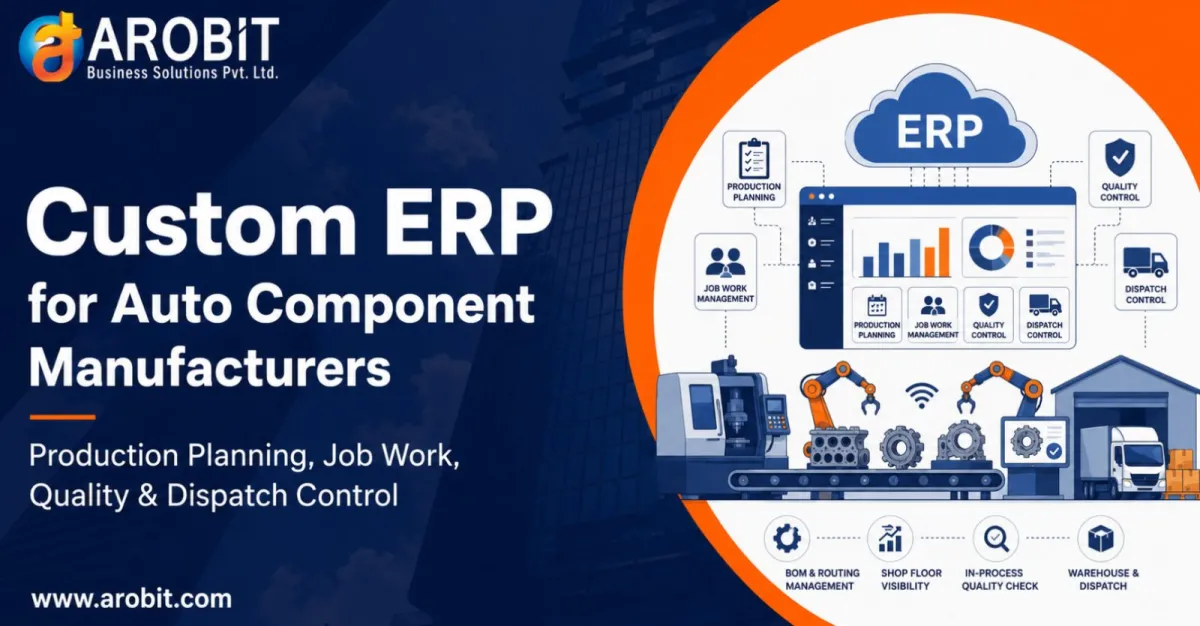
Auto component manufacturing is a highly process-driven industry where precision, traceability, and delivery performance directly affect customer relationships and profitability. Manufacturers must manage production schedules, raw material availability, outsourced job work, quality inspections, inventory movement, and dispatch commitments while maintaining tight control over costs.
Many businesses still rely on spreadsheets, disconnected software, and manual reporting processes to manage these operations. As production volumes increase and supply chains become more complex, these methods often create inefficiencies that affect productivity and decision-making.
This is why many organizations are investing in ERP for auto component manufacturers to gain better operational visibility and control across the entire manufacturing lifecycle.
Why Auto Component Manufacturers Need Industry-Specific ERP Systems
Auto component manufacturers operate differently from general manufacturing businesses. Production environments often involve multiple product variants, strict quality requirements, vendor-managed processes, and customer-specific delivery schedules.
Common operational challenges include:
Frequent production schedule changes
Raw material tracking difficulties
Outsourced job work management
Quality compliance requirements
Inventory discrepancies
Delayed dispatches
Lack of real-time production visibility
Customer-specific reporting demands
Generic software solutions often fail to address these industry-specific requirements. A purpose-built ERP for auto component manufacturers provides workflows designed around manufacturing operations rather than forcing businesses to adapt their processes.
Production Planning Challenges in Auto Component Manufacturing
Production planning is one of the most critical functions in any manufacturing operation.
Manufacturers must balance customer demand, machine capacity, workforce availability, raw material stock levels, and delivery commitments. Even minor planning errors can create production delays and missed dispatch targets.
Common planning issues include:
Overloaded work centers
Inaccurate capacity planning
Material shortages
Unplanned machine downtime
Inefficient production sequencing
Without real-time data, production teams often struggle to adjust schedules when conditions change.
An ERP for auto component manufacturers helps businesses create realistic production plans by integrating inventory, procurement, machine capacity, and sales orders into a single system. This improves resource utilization and reduces production bottlenecks.
Managing Job Work Operations More Effectively
Many auto component manufacturers outsource specific processes such as machining, coating, heat treatment, plating, assembly, or finishing to external vendors.
While job work provides operational flexibility, it also introduces additional complexity.
Manufacturers often face challenges such as:
Tracking material issued to vendors
Monitoring work-in-progress inventory
Measuring vendor performance
Managing delivery timelines
Tracking process costs
Manual tracking methods frequently result in delays, inventory discrepancies, and limited visibility into outsourced operations.
A well-designed ERP for auto component manufacturers allows businesses to manage the complete job work cycle, including material issue, vendor processing, receipt tracking, quality verification, and cost accounting.
This creates greater transparency and helps ensure that outsourced operations remain aligned with production schedules.
Quality Control Across the Manufacturing Process
Quality requirements in the automotive industry continue to become more stringent. Customers expect consistent product quality, process traceability, and documented inspection records.
A quality issue identified after dispatch can result in customer complaints, warranty claims, or production disruptions further down the supply chain.
Common quality management challenges include:
Inconsistent inspection processes
Delayed defect identification
Lack of traceability
Manual quality reporting
Difficulty tracking corrective actions
Quality management should not operate separately from production.
An ERP for auto component manufacturers integrates quality checkpoints directly into manufacturing workflows. Inspection results can be linked to production batches, work orders, raw materials, and finished goods, creating a complete quality history.
This helps businesses identify recurring issues faster and improve overall product consistency.
Inventory Control and Material Traceability
Inventory management is another critical area for auto component manufacturers.
Manufacturers need visibility into:
Raw materials
Work-in-progress inventory
Finished goods
Rejected materials
Vendor stock
Dispatch-ready inventory
Inventory inaccuracies can create production interruptions and affect customer commitments.
A centralized ERP system provides real-time inventory tracking across locations and departments. Material movement can be monitored from procurement through production and dispatch.
Many organizations implementing custom manufacturing software development initiatives prioritize inventory visibility because it directly affects production continuity and operational efficiency.
Dispatch Management and On-Time Delivery Performance
Production completion alone does not guarantee successful order fulfillment.
Dispatch delays often occur due to:
Incomplete documentation
Packaging bottlenecks
Inventory mismatches
Shipment scheduling conflicts
Warehouse coordination issues
These challenges can affect customer satisfaction even when production targets are achieved.
An ERP for auto component manufacturers helps coordinate production, warehouse, and logistics teams through a unified workflow.
Dispatch planning features typically include:
Shipment scheduling
Delivery tracking
Packing list generation
Dispatch documentation
Customer order monitoring
This improves delivery reliability and provides customers with greater visibility into order status.
Real-Time Reporting for Better Decision-Making
Manufacturing leaders require accurate information to make informed decisions.
When production, inventory, quality, and dispatch data exist in separate systems, reporting becomes time-consuming and often unreliable.
A centralized ERP platform provides dashboards and reports that help management monitor:
Production efficiency
Machine utilization
Inventory availability
Job work status
Quality performance
Dispatch readiness
This visibility enables faster decision-making and allows businesses to respond proactively to operational challenges.
Benefits of a Custom ERP Solution
Every manufacturing business operates differently.
Production processes, reporting requirements, approval workflows, and customer commitments often vary significantly between organizations.
This is where custom manufacturing software development provides a strategic advantage.
Instead of adapting business processes to match software limitations, manufacturers can implement ERP systems tailored to their operational requirements.
Key benefits include:
Process-specific workflows
Industry-focused reporting
Improved user adoption
Better operational visibility
Enhanced scalability
Reduced manual intervention
Greater data accuracy
Custom ERP solutions allow manufacturers to support current operations while preparing for future growth.
Key Features to Look for in ERP for Auto Component Manufacturers
When evaluating ERP solutions, manufacturers should consider capabilities such as:
Production Planning
Capacity planning
Production scheduling
Resource allocation
Work order management
Job Work Management
Vendor tracking
Material issue management
Cost monitoring
Process status visibility
Quality Management
Inspection workflows
Defect tracking
Quality reporting
Traceability management
Inventory Management
Real-time stock visibility
Batch tracking
Warehouse management
Material movement tracking
Dispatch Control
Order fulfillment monitoring
Shipment scheduling
Delivery tracking
Dispatch documentation
A solution that integrates all these functions provides better operational control and supports long-term manufacturing efficiency.
Conclusion
Auto component manufacturers operate in an environment where production efficiency, quality consistency, and delivery performance directly influence business success. Managing these functions through disconnected systems often limits visibility and creates operational challenges that affect productivity and profitability.
A modern ERP for auto component manufacturers helps organizations connect production planning, job work management, quality control, inventory tracking, and dispatch operations within a unified platform. This improves decision-making, reduces manual effort, and provides greater control across the manufacturing process.
For businesses looking to strengthen operational efficiency and build scalable manufacturing systems, experienced technology partners such as Arobit deliver industry-focused ERP and manufacturing software solutions designed to address real-world manufacturing challenges.
FAQs
1. What is ERP for auto component manufacturers?
ERP for auto component manufacturers is a specialized enterprise resource planning system designed to manage production planning, inventory, job work, quality control, procurement, and dispatch operations within automotive component manufacturing businesses.
2. How does ERP help manage outsourced job work?
ERP systems track materials issued to vendors, monitor processing status, manage receipts, calculate job work costs, and provide visibility into outsourced manufacturing activities.
3. Why is quality management important in auto component manufacturing ERP?
Quality management helps manufacturers maintain traceability, track inspections, reduce defects, support compliance requirements, and ensure consistent product quality throughout the production process.


Comments
No comments yet. Be the first to share your thoughts!