




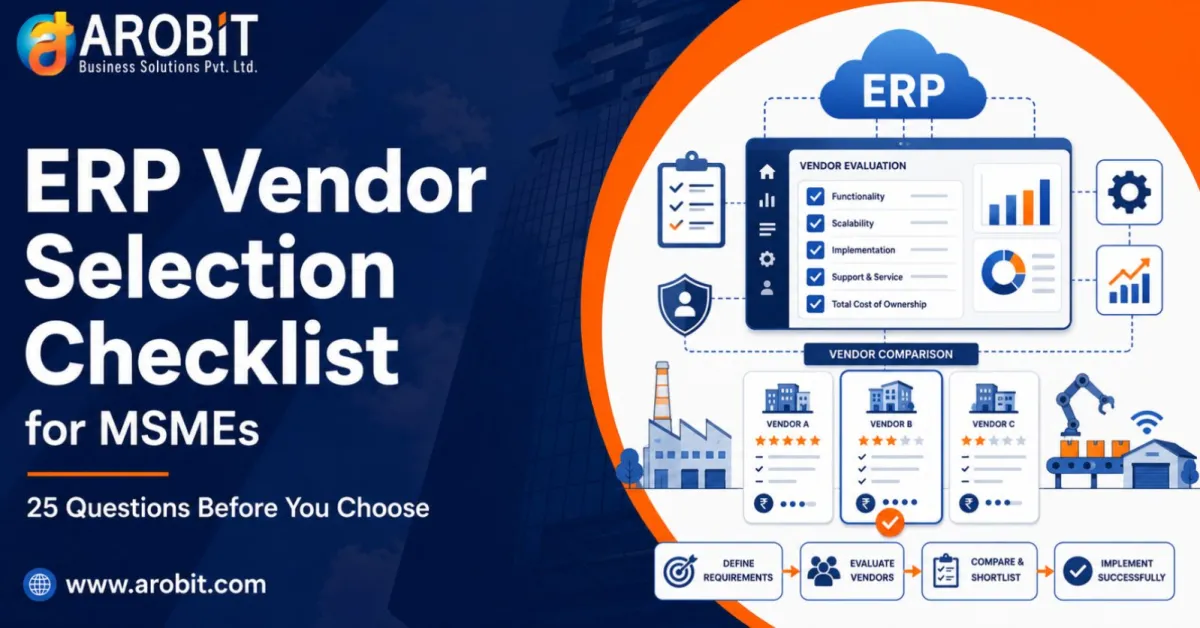
Selecting an ERP system is one of the most important technology decisions a manufacturing MSME can make. A well-implemented ERP can improve production planning, inventory control, procurement management, quality monitoring, and financial visibility. On the other hand, choosing the wrong solution can result in operational disruptions, unexpected costs, poor user adoption, and limited return on investment.
Many manufacturing businesses evaluate ERP software primarily based on features, pricing, or vendor presentations. While these factors are important, long-term success depends on asking the right questions before signing a contract.
This ERP vendor selection checklist will help manufacturing business owners evaluate ERP providers more effectively and make an informed decision that supports both current operations and future growth.
Why ERP Vendor Selection Matters
ERP implementation is not simply a software purchase. It is a business transformation initiative that affects multiple departments, workflows, and decision-making processes.
The right vendor should understand manufacturing operations, industry challenges, and implementation requirements. The focus should not only be on software functionality but also on the vendor's ability to support long-term business objectives.
Using a structured ERP vendor selection checklist reduces risk and helps organizations avoid costly mistakes.
Section 1: Industry Experience and Expertise
1. How much experience do you have serving manufacturing businesses?
A vendor with manufacturing expertise is more likely to understand production workflows, inventory management, quality control, and supply chain challenges.
2. Have you worked with businesses of our size?
Manufacturing MSMEs have different requirements than large enterprises. Ensure the vendor has relevant experience supporting similar organizations.
3. Can you provide manufacturing-specific case studies?
Real implementation examples provide insight into the vendor's capabilities and industry understanding.
4. Do you understand our specific manufacturing segment?
Requirements can vary significantly across industries such as automotive, pharmaceuticals, textiles, engineering, and process manufacturing.
5. Can we speak with existing manufacturing customers?
Customer references often provide practical insights beyond sales presentations.
Section 2: Product Capabilities
6. Does the ERP support production planning?
Production planning capabilities should include scheduling, work order management, capacity planning, and resource allocation.
7. Does the system provide inventory visibility in real time?
Inventory accuracy directly affects production continuity and procurement planning.
8. Can the ERP manage procurement workflows?
The solution should support purchase requests, vendor management, approvals, and procurement tracking.
9. Does it include quality management functionality?
Quality monitoring, inspections, corrective actions, and traceability should be available where required.
10. Can the system handle multiple business locations?
Many growing manufacturers operate multiple plants, warehouses, or distribution centers.
Section 3: Customization and Flexibility
Manufacturing businesses rarely follow identical processes.
11. How much customization is possible?
Business requirements often evolve over time. Flexibility is essential.
12. Can workflows be adapted to our processes?
The ERP should support operational requirements rather than forcing major process changes.
13. Will customizations affect future upgrades?
This question helps identify potential long-term maintenance challenges.
14. How are additional feature requests managed?
Understanding the vendor's development process is important for future enhancements.
15. Can the ERP integrate with existing systems?
Integration capabilities help eliminate data silos and improve operational visibility.
Many manufacturers evaluating manufacturing IT solutions prioritize integration because disconnected systems often create reporting and process inefficiencies.
Section 4: Implementation Approach
Implementation quality often determines project success.
16. What is your ERP implementation methodology?
A structured implementation framework reduces project risk.
17. How long does a typical implementation take?
Timelines should be realistic and aligned with business requirements.
18. Who will be responsible for implementation?
Clarify whether implementation will be handled internally, through partners, or by third-party consultants.
19. How will data migration be managed?
Migrating inventory, customer, supplier, production, and financial data requires careful planning.
20. What training will be provided?
User adoption improves significantly when teams receive comprehensive training.
A detailed ERP vendor selection checklist should always include implementation-related questions because deployment challenges often affect project outcomes more than software features.
Section 5: Support and Long-Term Partnership
ERP systems require ongoing support after deployment.
21. What support services are included?
Understand support coverage, service levels, and escalation procedures.
22. What are your response times for critical issues?
Manufacturing operations often require immediate attention when system issues occur.
23. How frequently are updates released?
Regular updates help maintain security, performance, and functionality.
24. What are the ongoing costs after implementation?
Review annual maintenance fees, licensing costs, support charges, and upgrade expenses.
25. What is your long-term product roadmap?
A vendor's product vision can indicate how well the solution will support future business growth.
Additional Evaluation Areas to Consider
Beyond the 25 core questions, manufacturing businesses should also evaluate:
Reporting and Analytics
The ERP should provide actionable operational insights, including:
Production performance reports
Inventory analytics
Procurement dashboards
Financial reporting
Quality metrics
Security and Data Protection
Questions should include:
How is data secured?
What backup processes are available?
How is user access managed?
What compliance standards are supported?
Scalability
Business growth often creates new requirements.
The ERP should support:
Increased transaction volumes
Additional locations
New product lines
Expanded workforce requirements
A future-ready ERP solution reduces the need for costly system replacements later.
Common Mistakes Manufacturing MSMEs Make During ERP Selection
Even experienced business owners sometimes overlook important evaluation criteria.
Common mistakes include:
Choosing Based on Price Alone
The lowest-cost solution may not provide the functionality or support required for long-term success.
Focusing Only on Features
Features matter, but implementation expertise and vendor support are equally important.
Ignoring User Adoption
A technically capable system provides little value if employees struggle to use it effectively.
Underestimating Data Migration
Poor data migration planning can create operational challenges after go-live.
Not Following a Structured Evaluation Process
A comprehensive ERP vendor selection checklist helps ensure that critical evaluation areas are not overlooked.
How the Right ERP Vendor Creates Long-Term Value
A successful ERP implementation improves much more than operational efficiency.
It helps businesses:
Improve production visibility
Reduce manual processes
Enhance inventory control
Strengthen quality management
Improve decision-making
Support business growth
The right vendor becomes a long-term technology partner rather than simply a software provider.
Organizations investing in manufacturing IT solutions often achieve better outcomes when they focus on vendor expertise, implementation quality, and long-term support rather than software features alone.
Conclusion
ERP selection is a strategic decision that can influence manufacturing performance for years. Taking the time to evaluate vendors thoroughly helps reduce implementation risks and improves the likelihood of achieving measurable business benefits.
This ERP vendor selection checklist provides a practical framework for manufacturing MSMEs to assess ERP providers, compare solutions, and make informed decisions based on operational requirements rather than marketing claims.
For manufacturers seeking industry-focused ERP solutions, companies such as Arobit bring extensive experience in manufacturing software, process automation, and business system implementation, helping organizations build technology foundations that support operational efficiency and long-term growth.
FAQs
1. Why is an ERP vendor selection checklist important?
An ERP vendor selection checklist helps businesses evaluate vendors systematically, reduce implementation risks, and ensure the chosen solution aligns with operational and business requirements.
2. What is the most important factor when selecting an ERP vendor?
Industry expertise is often one of the most important factors because vendors with manufacturing experience better understand production processes, inventory management, quality control, and operational challenges.
3. How long does ERP implementation typically take for a manufacturing MSME?
Implementation timelines vary depending on business complexity, customization requirements, data migration needs, and user training. Projects can range from a few months to longer for more complex environments.


Comments
No comments yet. Be the first to share your thoughts!