




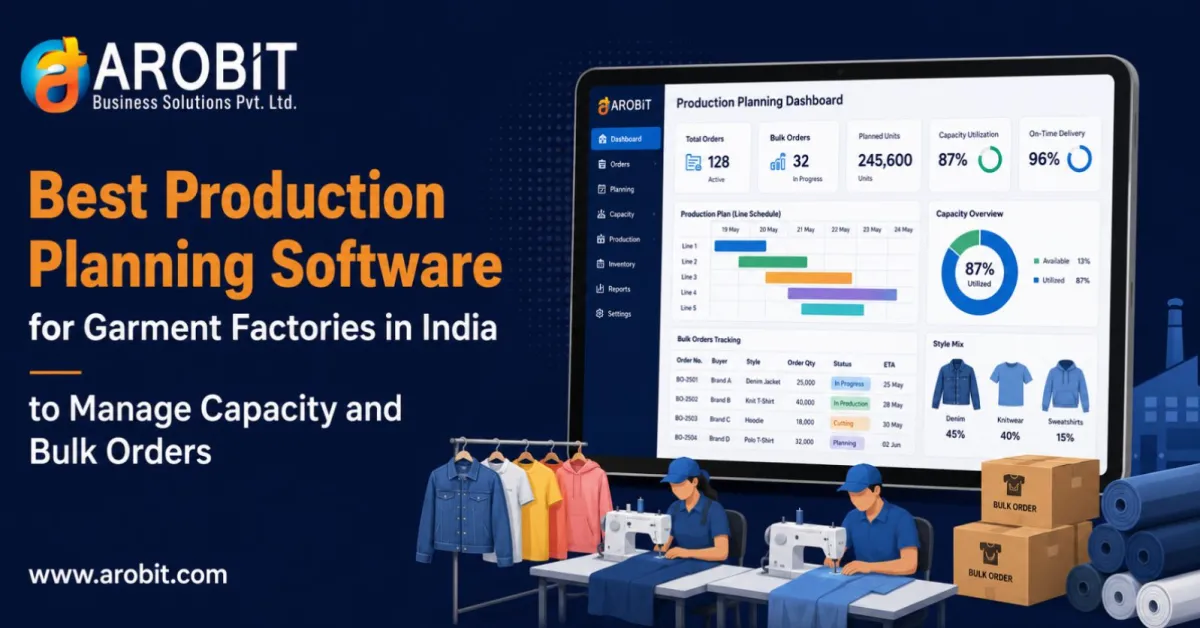
The Indian garment manufacturing sector operates in an environment where delivery schedules, seasonal demand, export commitments, and changing customer preferences leave little room for production delays. Managing hundreds of styles, multiple production stages, and fluctuating order volumes using spreadsheets or disconnected systems often leads to missed deadlines, idle machines, and inventory mismatches.
This is where production planning software for garment factories in India becomes an essential business tool. Instead of relying on manual coordination, manufacturers can gain better visibility into production schedules, machine capacity, workforce allocation, and order progress from a centralized platform.
This article explores how modern production planning software helps garment manufacturers improve efficiency, manage bulk orders, and make informed production decisions.
Why Production Planning Is Challenging for Garment Manufacturers
Garment manufacturing involves multiple interconnected processes, including fabric sourcing, cutting, stitching, embroidery, washing, finishing, quality inspection, packing, and dispatch. A delay in any one stage can affect the entire production timeline.
Some of the common challenges include:
Managing multiple customer orders simultaneously
Allocating machine and labor capacity efficiently
Tracking work-in-progress across departments
Coordinating subcontractors and vendors
Handling urgent or high-priority orders
Meeting export delivery schedules
Preventing production bottlenecks
Many manufacturers still rely on spreadsheets or manual updates, making it difficult to identify delays before they impact delivery commitments.
How Production Planning Software Helps Garment Factories
A modern production planning software for garment factories in India brings every stage of production onto a single platform. Instead of working with disconnected information, production teams can monitor capacity, schedule jobs, assign resources, and track progress in real time.
The software enables better communication between planning, procurement, production, quality, and dispatch teams, helping everyone work from the same information.
Key Features to Look for in Production Planning Software
When evaluating solutions, garment manufacturers should focus on capabilities that directly improve operational planning.
Production Scheduling
Effective production scheduling software for garment industry helps planners organize production orders based on delivery dates, machine availability, workforce capacity, and production priorities.
Instead of manually updating production calendars, schedules can be adjusted quickly when priorities change.
Capacity Planning
An efficient capacity planning software for garment manufacturing provides visibility into machine utilization, operator availability, and production loads.
This helps manufacturers:
Balance workloads
Reduce idle production time
Prevent machine overloading
Plan overtime more effectively
Accurate capacity planning also improves delivery commitments for large customers.
Bulk Order Management
Managing large customer orders becomes easier with dedicated bulk order management software for garment factories. Production managers can divide orders into batches, monitor progress at every stage, and identify delays before they affect shipment schedules.
This is particularly valuable for export manufacturers handling thousands of garments across multiple styles and sizes.
Benefits of Garment Production Planning Software
Choosing the right garment production planning software in India offers several operational advantages.
Better Production Visibility
Managers gain access to dashboards showing production status, pending orders, work-in-progress, and completed quantities without collecting updates from multiple departments.
Improved Resource Utilization
Machines, operators, and production lines can be allocated more efficiently, reducing downtime and improving productivity.
Faster Decision-Making
Production planners can identify bottlenecks early and reschedule operations before delays become significant.
Higher On-Time Deliveries
Accurate scheduling and better coordination help manufacturers meet customer deadlines more consistently.
Reduced Manual Errors
Automated planning minimizes calculation mistakes, duplicate entries, and communication gaps that often occur with spreadsheet-based planning.
Managing Multi-Stage Garment Manufacturing Efficiently
Garment manufacturing rarely follows a single linear process. Different products may require embroidery, printing, washing, finishing, or specialized quality checks.
A comprehensive garment factory planning software enables manufacturers to define production workflows based on product requirements. Each department can update job status independently while production managers monitor the overall progress.
This improves coordination across:
Cutting
Stitching
Embroidery
Printing
Washing
Finishing
Packing
The Importance of Multi-Process Order Management
Large garment factories often process multiple customer orders simultaneously, each requiring different production sequences.
A reliable multi-process order management software helps production teams:
Track multiple production stages
Monitor order completion percentages
Prioritize urgent customer requirements
Allocate resources dynamically
Reduce production conflicts
Having centralized order tracking significantly improves operational control.
Integrating Production Planning with ERP
Production planning becomes even more effective when connected with a custom ERP for garment production planning. Instead of operating as a standalone application, production data can integrate with inventory, procurement, finance, quality management, warehouse operations, and sales.
This integration allows businesses to:
Check raw material availability before scheduling
Monitor inventory consumption automatically
Generate production reports
Track production costs
Improve purchase planning
A connected ERP environment provides better decision support across departments.
Supporting Apparel Manufacturers with Better Planning
Modern apparel production planning software in India is designed to support manufacturers handling multiple product categories, seasonal collections, export orders, and private-label production.
Features such as production calendars, line balancing, operator efficiency tracking, and production analytics help businesses improve overall manufacturing performance.
Instead of reacting to production delays, manufacturers can identify risks early and take corrective action.
Choosing the Right Production Planning Solution
Not every software solution is suitable for garment manufacturing. Before making a decision, manufacturers should evaluate several factors.
Consider whether the software can:
Support multiple production workflows
Scale with business growth
Integrate with ERP and inventory systems
Handle large production volumes
Provide customizable reports
Offer real-time production dashboards
Support mobile access for supervisors
Businesses should also evaluate implementation support, customization capabilities, training, and long-term technical assistance.
Working with an experienced garment manufacturing software development company ensures that the solution aligns with factory operations instead of forcing teams to adapt to generic workflows.
Why Custom Production Planning Software Matters
Every garment factory follows different production methods, product categories, quality standards, and customer requirements.
A custom-built solution allows manufacturers to configure:
Production workflows
Approval processes
Capacity planning rules
Machine allocation
Production reports
Role-based dashboards
Business-specific KPIs
Rather than changing factory operations to match software limitations, customized applications support existing processes while improving efficiency.
Selecting a reliable garment manufacturing software development company can make implementation smoother and ensure the software continues to evolve alongside business needs.
Future Trends in Garment Production Planning
Technology continues to improve production planning through automation and data-driven decision-making.
Manufacturers are increasingly adopting solutions that provide:
Real-time production monitoring
Predictive production analytics
Automated production scheduling
Demand forecasting
Digital production dashboards
Workflow automation
Mobile production updates
As production complexity increases, manufacturers that adopt intelligent planning systems are better positioned to improve productivity, reduce operational costs, and maintain delivery performance.
Conclusion
Managing production capacity and large customer orders requires more than spreadsheets and manual coordination. The right production planning software for garment factories in India provides greater visibility into production activities, improves resource utilization, and helps manufacturers meet delivery commitments with greater confidence.
Businesses looking to modernize their production planning should evaluate solutions that combine scheduling, capacity planning, workflow management, and ERP integration into a unified platform.
For manufacturers seeking customized production planning and enterprise software tailored to their operational processes, Arobit brings extensive experience in developing technology solutions for the manufacturing sector. Its consultative approach helps businesses implement software that supports efficient production planning, better operational visibility, and long-term business growth.
Frequently Asked Questions (FAQs)
1. What is production planning software for garment factories?
Production planning software helps garment manufacturers schedule production, allocate resources, track work-in-progress, manage capacity, and monitor customer orders from a centralized platform.
2. How does production planning software improve bulk order management?
It provides real-time visibility into production progress, distributes workloads efficiently, tracks multiple production stages, and helps manufacturers identify delays before they affect delivery schedules.
3. Can production planning software integrate with ERP systems?
Yes. Most modern solutions integrate with ERP platforms to connect production planning with inventory, procurement, finance, warehouse management, quality control, and reporting, providing better operational visibility across the business.



Comments
No comments yet. Be the first to share your thoughts!