




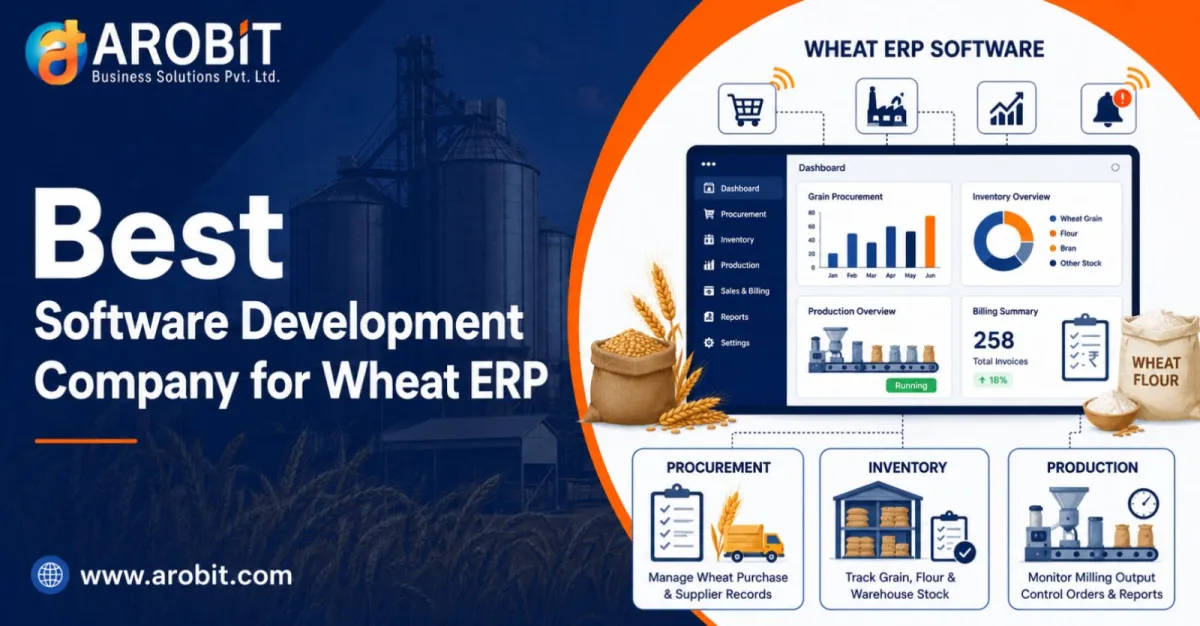
A wheat mill can receive grain from multiple suppliers, inspect incoming quality, store wheat by lot or grade, issue material for milling, record flour output, manage by-products, and dispatch finished products to distributors. If procurement, production, warehouse, and finance teams maintain separate records, tracing the actual cost and status of each operation becomes difficult.
Choosing the best software development company for wheat ERP is therefore not only a technology decision. The software partner needs to understand how wheat moves from procurement and inward inspection through storage, milling, packing, inventory, and sales. A technically capable vendor may still build an unsuitable system if the team does not understand mill operations.
This blog explains the practical factors wheat and flour mill businesses should evaluate before selecting an ERP development partner.
Start by Understanding Your Wheat Mill ERP Requirements
Before searching for the best software development company for wheat ERP, document the operational problems the ERP needs to solve.
One mill may struggle with raw wheat inventory accuracy. Another may lack visibility into production yield. A multi-unit business may need consolidated reports from mills and warehouses. The ERP requirement should begin with these business problems rather than a generic list of software modules.
A custom ERP software for wheat mill may need to support:
Wheat procurement and supplier records
Inward material inspection
Lot or batch tracking
Silo and warehouse inventory
Milling production
Yield monitoring
By-product management
Packaging material inventory
Sales and dispatch
Finance and reporting
A suitable wheat ERP software development company should study how these processes currently operate before recommending the system structure.
Look for Practical Understanding of Wheat Milling Operations
Software development experience alone does not guarantee a successful mill ERP implementation. The development team should be able to understand the operational relationship between raw wheat, production, finished flour, and by-products.
For example, wheat received from different suppliers may vary by grade, moisture, or other quality parameters defined by the mill. Production teams may need to know which stock is available before planning a milling run. Management may want to compare input quantities with flour and by-product output.
A wheat mill ERP development company should be able to map these dependencies clearly.
When evaluating the best software development company for wheat ERP, ask the vendor to explain how its proposed system would manage a complete operational workflow. The response should cover actual process steps rather than only dashboards and technology features.
Evaluate Experience with Grain and Agro-Processing Systems
Wheat mills operate within the broader grain and agro-processing sector. Inventory and production requirements can differ considerably from those of general manufacturing businesses.
A software development company for grain milling ERP should understand material movement, production conversion, warehouse dependencies, procurement, and quality-related workflows.
Similarly, experience with ERP software development for agro processing industry improvement software requirements can help a development team recognize the operational challenges created by raw material variability, seasonal procurement, and production-linked inventory.
Ask potential vendors about the types of production and inventory systems they have developed. A company does not necessarily need to sell a pre-built wheat ERP, but it should demonstrate an ability to understand process-driven operations.
The best software development company for wheat ERP should ask detailed questions about the mill before suggesting a solution.
Check Whether the ERP Can Support Wheat Procurement
Raw wheat procurement has a direct effect on inventory availability, production planning, and material costs.
A wheat flour mill ERP software provider should be able to connect supplier records, purchase requirements, purchase orders, material receipts, and inventory updates.
Depending on the mill's process, procurement workflows may also need to capture:
Supplier information
Wheat grade or category
Purchase quantity
Agreed price
Delivery schedule
Material receipt
Quality status
Accepted or rejected quantity
A capable wheat flour mill ERP software provider should explain how procurement information will move into inventory and production processes.
Businesses evaluating Mills Manufacturing IT Services should also assess whether the provider can adapt purchase and approval workflows to the mill's operating structure.
Assess Inventory and Lot-Level Visibility
Knowing the total quantity of wheat in stock may not provide enough information for production teams.
Mill managers may need to understand where material is stored, when it was received, its lot or supplier reference, and whether it is available for production.
A grain mill ERP software company should provide clear inventory movement and stock visibility. The system may need to track raw wheat, packaging materials, finished flour products, and by-products across different storage locations.
The right grain mill ERP software company should also consider how physical material movement is recorded. If warehouse teams update the ERP hours after a transfer, system inventory may not reflect actual stock conditions.
This is why the best software development company for wheat ERP should examine user workflows as carefully as technical architecture.
Review Production and Yield Management Capabilities
Production reporting is a central part of wheat mill ERP.
The system should help teams record material issued for milling, production output, process information, finished products, and by-products based on the mill's workflow.
A custom ERP software for wheat mill can be configured around specific production stages and reporting requirements. For example, management may want to compare wheat input with flour output for a production run and review the associated by-product quantities.
When reviewing mill and grain software solutions, ask how the proposed system manages production records and yield information.
Effective mill and grain software solutions should give production and management teams consistent information without requiring data to be manually reconciled from separate spreadsheets.
Understand the Importance of Customization
A small flour mill, a multi-location milling business, and an agro-processing enterprise may have very different reporting and approval requirements.
Custom software solutions for mill and grain businesses allow ERP workflows to reflect actual operational structures.
Customization may be required for:
Mill-specific production stages
Purchase approval rules
Quality inspection workflows
Warehouse structures
Product and by-product classifications
Management dashboards
Custom production reports
Existing accounting integrations
The best software development company for wheat ERP should distinguish between necessary customization and unnecessary software complexity.
Well-planned custom software solutions for mill and grain operations should solve documented process gaps. Adding features without a clear operational purpose can make the ERP harder for employees to use.
Check Integration Capabilities
ERP rarely operates in complete isolation. A wheat mill may already use accounting applications, weighbridge systems, laboratory processes, sales platforms, or other business applications.
A software development company for grain milling ERP should assess existing systems before defining the ERP architecture.
Ask vendors:
Which existing systems can be integrated?
How will data move between applications?
Which system will maintain the primary record?
How will integration errors be identified?
Can future applications connect with the ERP?
A reliable wheat ERP software development company should document integration requirements during process discovery rather than addressing them only after development begins.
Evaluate Reporting and Management Visibility
ERP dashboards should answer business questions, not simply display large volumes of data.
Mill owners and managers may need reports related to:
Raw wheat stock
Pending procurement
Production quantities
Yield information
Finished goods inventory
By-product output
Sales orders
Dispatch status
The best ERP company for wheat mill industry should understand which information is required by operational users and which reports are intended for management.
When evaluating the best ERP company for wheat mill industry, ask to see how reports can be filtered by date, location, product, production run, or other relevant parameters.
The best software development company for wheat ERP should design reporting around decision-making requirements instead of creating the same dashboard for every user.
Review the Vendor's ERP Development Process
A development company's process can reveal how thoroughly it understands business requirements.
A reliable wheat mill ERP development company should begin with process discovery and requirement analysis. Development should not start after a short feature discussion.
A structured ERP project may include:
Operational process study
Requirement documentation
Workflow mapping
Module and system planning
UI and reporting requirements
Development and integration
Testing
Data migration
User training
Deployment and support
Businesses assessing Mills Manufacturing IT Services should ask who will conduct requirement discussions and how operational feedback will be incorporated during development.
The best software development company for wheat ERP should maintain clear communication between business stakeholders and the software team throughout the project.
Ask About Data Migration and ERP Implementation
Existing mill data may be spread across spreadsheets, accounting applications, manual registers, and older software.
Moving this information into a new ERP requires planning.
The development company should review:
Supplier records
Product masters
Raw material information
Current inventory
Customer records
Pending purchase orders
Pending sales orders
Opening financial data, where applicable
Experience with ERP software development for agro processing industry improvement software projects should include an understanding of how operational data is validated before migration.
Implementation should also define which modules will go live first. A phased approach may be more practical when procurement, inventory, production, sales, and finance teams need time to adapt to new workflows.
Consider User Training and Long-Term Support
An ERP can be technically correct but still fail to provide useful operational information if employees do not follow the intended process.
The best software development company for wheat ERP should include user training and implementation support in the project plan.
Training should be role-specific. A warehouse user does not need the same training as a production manager or finance team member.
Support requirements should also be discussed before signing the project agreement. Ask how software issues are reported, how updates are handled, and how future process changes will be evaluated.
A dependable software partner should treat ERP implementation as an ongoing business system project rather than a one-time application delivery.
Questions to Ask Before Selecting a Wheat Mill ERP Development Company
Before choosing a software partner, ask practical questions such as:
How will you study our current mill processes?
Can the ERP track raw wheat and finished products?
How will production and yield information be recorded?
Can the system manage multiple warehouses or mill locations?
How will existing software be integrated?
What is your data migration process?
Can reports be configured for different management roles?
What training is included?
How are future ERP changes handled?
What post-implementation support is available?
The answers can help businesses identify whether a vendor understands the operational requirement or is simply presenting a generic ERP platform.
Conclusion
Selecting the best software development company for wheat ERP requires more than reviewing technology stacks, software demonstrations, or development costs. Wheat mills should assess whether the software team understands procurement, raw material inventory, milling production, yield information, warehouse movement, finished products, and reporting dependencies.
The right development partner should study existing workflows, identify information gaps, and define how ERP modules will work together. Whether a mill needs production control, inventory visibility, multi-location reporting, or a connected enterprise system, software decisions should begin with actual operational requirements.
Arobit has experience in custom ERP, manufacturing software, workflow automation, and enterprise application development. For wheat mills and process-driven businesses evaluating a connected ERP system, Arobit can help study operational processes and develop software aligned with production, inventory, procurement, warehouse, and management reporting needs.
Frequently Asked Questions
1. What should a wheat mill look for in an ERP software development company?
A wheat mill should evaluate the company's understanding of procurement, raw material inventory, production, yield reporting, warehouse processes, integrations, and ERP implementation. The provider should conduct process discovery before recommending modules or workflows.
2. Why is custom ERP useful for wheat and flour mills?
Custom ERP can support mill-specific production processes, inventory structures, approval workflows, quality requirements, and reports. It is useful when standard ERP workflows do not match the way the mill operates.
3. Can wheat mill ERP integrate with existing business applications?
Yes. Depending on technical compatibility and business requirements, ERP can be integrated with accounting systems, weighbridge applications, sales platforms, and other business software. Integration requirements should be assessed during the ERP planning stage.


Comments
No comments yet. Be the first to share your thoughts!