




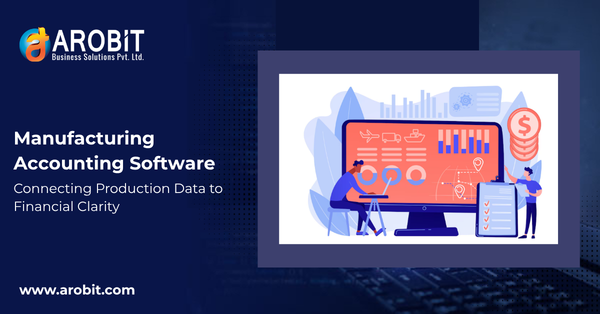
When your production floor is running at full capacity but your books tell a different story at month-end, the problem is rarely your accountant. It is the gap between what happens on the shop floor and what gets recorded in your ledgers.
A batch completes. Material was consumed, labour was deployed, power was used, and finished goods moved to the warehouse. But by the time any of this reaches your accounting team, it has passed through three people, two spreadsheets, and at least one WhatsApp message. Numbers get rounded. Entries get delayed. And the cost of that batch — what it actually cost to produce — becomes a figure that nobody fully trusts.
This is the core problem that manufacturing accounting software is designed to solve. Not by adding another layer of reporting on top of broken data, but by connecting the source of every cost — the production floor — directly to your financial records.
Why Standard Accounting Tools Fall Short in Manufacturing
A generic accounting tool records what you tell it to. It does not know that the 4,200 kg of raw material your storekeeper issued yesterday was split across three production orders, that 180 kg of it was rejected mid-process, or that the finished output came in 2.3% below standard yield.
You have to tell it all of that manually. And by the time you do, the production order is closed, the floor supervisor has moved on, and the storekeeper is working through today's GRNs.
Manufacturing businesses carry costs that standard tools simply cannot track without manual effort at every step:
- Raw material consumption per batch
- Packing material usage
- Yield loss
- Rework cost
- Labour allocation per production order
- Overhead absorption
Each of these has a financial consequence. None of them originate in accounts — they originate on the floor.
When these costs are fed into accounting manually, you get delays, approximations, and reconciliation arguments at month-end. When they flow automatically from production records, your accounts are current, accurate, and auditable every single day.
How Manufacturing Accounting Software Connects the Two Worlds
The connection starts at the Purchase Order. When a PO is raised, it carries item, quantity, rate, and supplier — all the information needed to create a payables entry the moment the GRN is confirmed. The system does not wait for someone to copy the invoice into the accounting module. The GRN creates the liability automatically, linked to the specific lot, supplier, and purchase order.
From there, when material is issued against a production order, the system records the consumption entry immediately — quantity drawn, lot used, standard cost applied. If yield at the end of the batch is 94% instead of the standard 96%, the variance is calculated and posted to the variance ledger automatically. The cost of that 2% loss is visible, attributed to the right batch, and ready for review.
Dispatch triggers the billing workflow. When goods leave the warehouse through the dispatch module — with weighbridge-confirmed net weight — the system generates the sales voucher, updates finished goods inventory, and creates the receivables entry. The sales figure in your books matches what physically left your factory, to the kilogram.
Broker commissions are computed on confirmed sales, settled against the broker ledger, and cleared without manual intervention. Month-end does not require chasing operations for consumption figures or asking dispatch for load records. The data is already in the system — it was entered when the work actually happened.
This is what purpose-built manufacturing ERP accounting delivers: financial records that are a direct reflection of operations, not a delayed summary of them.
What Leadership Actually Sees Differently
When production data flows into accounting in real time, the monthly P&L stops being a historical document and starts being a management tool. A manufacturing software development company that understands this builds accounting modules around production workflows — not the other way around.
These figures are available within the same period in which they were incurred:
- Cost per unit
- Batch-wise profitability
- Raw material cost variance
- Overhead recovery
Plant heads and MDs stop waiting for the 10th of next month to understand what last month cost them.
FAQs
Q1. Can manufacturing accounting software handle multi-product cost tracking?
Yes. It assigns costs at the production order level — so if you run five products on the same line in a week, each carries its own material cost, yield loss, labour allocation, and overhead. Profitability is tracked by product, not just by factory.
Q2. How does it handle raw material price fluctuations in cost calculations?
The system applies weighted average cost or a standard cost method to inventory valuation. When raw material prices change across lots, the variance is captured at GRN level and reflected in cost of production automatically — no manual adjustment needed at month-end.
Q3. Is this only relevant for large manufacturing units?
Not at all. Mid-scale and growing manufacturers often have the most to gain. When you are managing production across 3 to 5 product lines without a large accounts team, manufacturing software development services that automate cost-to-ledger flows reduce your dependency on manual effort and gives your finance team accurate data without expanding headcount.
Conclusion
Manufacturing units that have made this shift — from manual cost entries to system-driven financial flows — consistently report faster month-end closing, fewer reconciliation disputes, and cost visibility that actually influences production decisions.
Arobit has built manufacturing accounting and ERP systems for production businesses across flour milling, FMCG, logistics, and distribution — where the brief was not just to digitise accounts but to connect every production transaction to a financial outcome. The approach is always the same: understand the floor first, then build the system around how work actually happens.
This is where manufacturing accounting software stops being a back-office tool and becomes the financial backbone of how your factory operates.






Comments
No comments yet. Be the first to share your thoughts!