




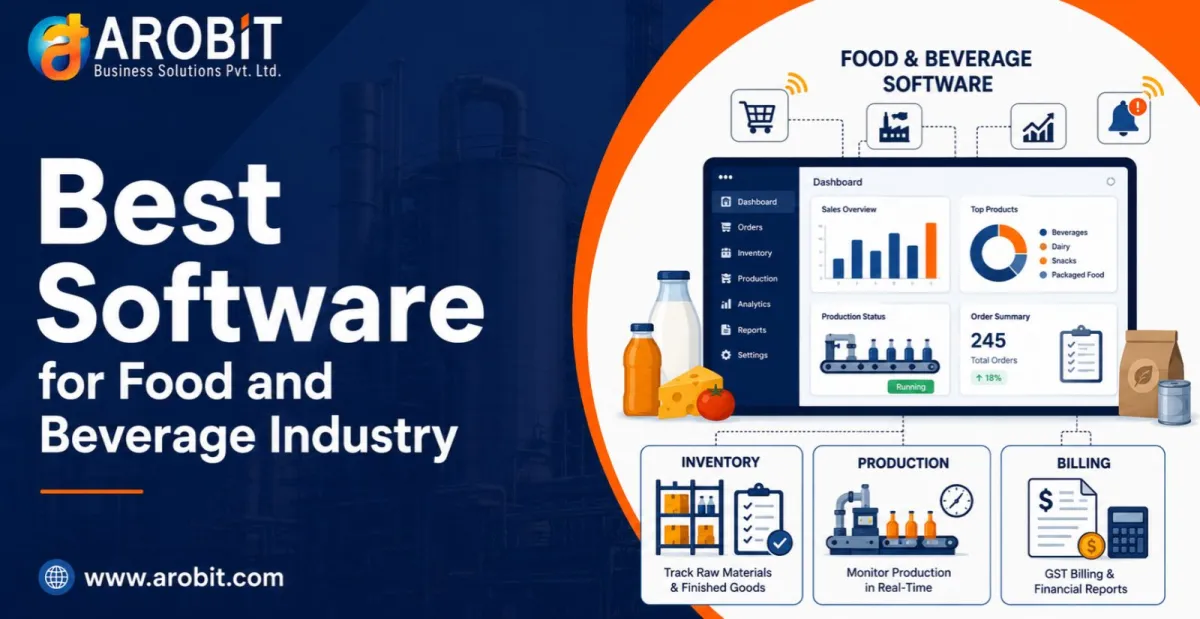
A food manufacturer may purchase raw materials from dozens of suppliers, run multiple production batches, inspect ingredient quality, manage expiry-sensitive stock, and coordinate warehouse dispatches within the same working day. A restaurant group faces a different set of challenges: recipe-level consumption, outlet inventory, purchasing, wastage, and centralized reporting. Standard business applications often struggle to manage these operational differences.
The best software for the food and beverage industry should match how a food business actually operates. It must connect purchasing, inventory, production, quality, sales, and reporting without forcing teams to maintain separate spreadsheets between processes.
Choosing the right system, however, requires more than comparing feature lists. This blog explains the essential software capabilities, practical use cases, and selection factors food and beverage businesses should evaluate before investing in a new system.
Why Food and Beverage Businesses Need Industry-Specific Software
Food operations involve material characteristics and process controls that many general business systems are not designed to handle. Ingredients may have short shelf lives. Production may depend on recipes or formulations. A single raw material can be used across several finished products, while quality approval may be required before the received stock enters production.
The best software for the food and beverage industry provides visibility across these connected activities.
For example, a production manager should be able to review whether ingredients are available before scheduling a batch. Procurement teams need visibility into shortages and pending purchase orders. Warehouse teams need accurate material status, while management requires current information on production and inventory.
This is why food and beverage industry software must support operational workflows rather than simply maintain financial or sales records.
Essential Features of Food and Beverage Software
Software requirements vary between a dairy producer, a beverage manufacturer, a packaged food company, a food processor, and a restaurant chain. Still, several capabilities are important across the sector.
Inventory and Expiry-Sensitive Stock Management
Food businesses cannot manage inventory only by the total available quantity. Teams may need visibility into batches, lots, expiry dates, stock locations, and material status.
Inventory software for the food and beverage industry helps businesses monitor raw materials, packaging items, work-in-progress, and finished products from a centralized system.
An effective inventory software for the food and beverage industry may also support batch-level stock records and material movement between warehouses or production locations. This gives teams better information when planning consumption or dispatch.
Production and Batch Management
Manufacturers need to know what is being produced, which materials are required, and how much output has been completed.
Food manufacturing software can connect production orders with material requirements, batch activities, and finished goods reporting. A beverage company, for example, may need to coordinate concentrates, sweeteners, bottles, caps, and labels for one production schedule.
Using food manufacturing software reduces the need to reconcile production information manually at the end of each shift.
Procurement and Supplier Management
Ingredient availability directly affects production continuity. Software should help procurement teams review stock, requirements, supplier records, open orders, and expected deliveries.
The best software for the food and beverage business connects purchasing decisions with inventory and production requirements. Buyers can identify shortages before raising purchase orders rather than relying only on departmental requests.
For growing organizations, the best software for the food and beverage business should also support supplier histories, purchase approvals, and pricing records.
ERP for Connected Food and Beverage Operations
Separate applications for procurement, production, warehouse, and finance can create information gaps. Teams may spend hours matching records between systems before management receives a usable report.
ERP software for the food and beverage industry connects core operational departments through shared business data. A material receipt can update warehouse information, move into quality inspection, become available for production after approval, and later contribute to production costing.
A well-configured ERP software for the food and beverage industry can support the following:
Procurement and purchase orders
Inventory and warehouse management
Production planning
Batch processing
Quality workflows
Sales and distribution
Financial reporting
Food and Beverage ERP Software is particularly relevant for manufacturers that need consistent processes across departments, facilities, or business locations.
Software Use Cases Across the Food and Beverage Sector
The best software for the food and beverage industry should be evaluated against specific operational use cases. A system suitable for a packaged snack manufacturer may not meet the needs of a multi-outlet restaurant business.
Food Processing Operations
Processors often manage raw material intake, production stages, quality checks, and finished product inventory.
Food processing software solutions can help teams record material movement and monitor processing activities from input to finished output. For example, a fruit processor may need to manage incoming raw material, grading, processing, packing, and finished stock.
The right food processing software solutions provide managers with clearer information about production progress and material utilization.
Restaurant and Multi-Outlet Food Businesses
Restaurants and food service businesses need visibility into purchasing, ingredient stock, consumption, and outlet-level operations.
Restaurant and food business software can connect centralized purchasing with individual outlet requirements. Management can review stock information across locations and identify unusual consumption patterns.
For a growing chain, restaurant and food business software may also support standardized workflows across outlets while maintaining centralized reporting.
Food Supply Chain Management
Food supply chains involve suppliers, warehouses, manufacturing locations, distributors, and sometimes temperature-sensitive logistics.
Supply chain software for food industry helps businesses coordinate material availability and movement across these operational points.
With supply chain software for food industry, teams can gain better visibility into pending supplies, stock locations, material transfers, and distribution requirements. This becomes important when businesses operate multiple warehouses or production facilities.
How Food Technology Software Supports Better Decisions
Software should do more than store transactions. Operational data becomes more useful when teams can review trends, exceptions, and current business conditions.
Modern food tech software solutions may provide dashboards for production status, inventory levels, purchase requirements, quality records, and order progress.
For example, if a material is being consumed faster than expected, managers should be able to identify the variance before it creates a shortage. Similarly, delayed production orders should be visible without waiting for a weekly report.
Well-designed food tech software solutions help decision-makers focus on operational exceptions rather than manually compiling data.
When Custom Food and Beverage Software Is the Better Choice
Off-the-shelf applications work well when business processes match standard workflows. Problems arise when manufacturers have unique production stages, approval structures, quality procedures, or reporting requirements.
Custom software for the food and beverage industry allows businesses to configure workflows around their actual operations.
A manufacturer may require the following:
Product-specific production processes
Material approval workflows
Custom quality checkpoints
Multi-level purchase approvals
Batch-specific reports
Role-based operational dashboards
Integration with existing applications
In these cases, custom software for the food and beverage industry can address process requirements that generic platforms may not support effectively.
Working with an experienced F&B software development provider also helps businesses assess which workflows should be automated and which existing processes need to be redesigned before implementation.
Evaluating Food Manufacturing and ERP Software
Selecting the best software for the food and beverage industry requires a structured assessment of business requirements.
Before reviewing vendors, document the operational problems the software needs to solve. If inventory discrepancies are the main issue, understand where stock records become inaccurate. If production delays are frequent, identify whether the problem starts with planning, material shortages, or reporting gaps.
The software evaluation should consider:
Industry-specific functionality
Batch and lot management capabilities
Inventory visibility
Production workflow support
Quality management requirements
Supplier and procurement processes
Reporting capabilities
Integration requirements
User access and security
Implementation support
A food and beverage industry software platform should also be evaluated for usability. A feature-rich system provides limited value if warehouse supervisors, production teams, or procurement users find routine tasks difficult to complete.
Understanding the Role of a Food Manufacturing System
A food manufacturing system or standalone production application may solve one operational problem effectively, but businesses should also consider how information moves between departments.
For example, purchasing data affects inventory. Inventory affects production planning. Production affects finished stock. Finished stock affects sales and dispatch.
This connected relationship is one reason the best software for the food and beverage industry often requires ERP-level integration rather than isolated applications.
A Food and Beverage ERP Software implementation can create a shared operational structure where departments use connected data while maintaining process-specific responsibilities.
Questions to Ask Before Selecting Software
Before signing with a software vendor, food businesses should ask practical questions rather than focusing only on demonstrations.
Consider asking:
Can the software support our actual production workflow?
How are batches, lots, and expiry dates managed?
Can quality status control material availability?
Does procurement connect with inventory requirements?
Can the system support multiple warehouses or facilities?
Which reports can our teams configure?
How will existing data be migrated?
What user training is included?
Can the software integrate with our current systems?
How are future process changes handled?
The best software for food and beverage industry should solve clearly defined operational problems. Purchasing a large system without documenting those problems can result in unused modules and complicated workflows.
Why Implementation Planning Matters
Software selection is only one part of the project. Data preparation, process mapping, user roles, training, and phased implementation directly influence how teams adopt the new system.
An experienced F&B software development team should first understand existing workflows, reporting dependencies, and operational pain points. This makes it easier to determine whether customization, integration, or process changes are necessary.
Implementation should also include clear ownership within the food business. Production, procurement, inventory, quality, and finance teams need to participate where their processes are affected.
Conclusion
The best software for food and beverage industry is not necessarily the application with the longest feature list. The right system is one that fits the business's production processes, inventory controls, procurement workflows, quality requirements, and reporting needs.
Manufacturers, processors, restaurant groups, and food businesses should evaluate software using real operational use cases. Whether the requirement involves food manufacturing software, ERP, inventory management, or food processing software solutions, the selection process should begin with clearly documented business challenges.
Arobit has experience in custom ERP, enterprise applications, workflow automation, and software for process-driven industries. For food and beverage businesses evaluating new systems, Arobit can help assess operational requirements and develop connected solutions that support production, inventory, procurement, warehouse, and quality processes.
Frequently Asked Questions
1. What is the best software for food and beverage industry?
The best software depends on the business's operational requirements. Manufacturers may need production, batch, inventory, quality, and procurement capabilities, while restaurant groups may prioritize outlet inventory, purchasing, and centralized reporting. The software should match actual workflows and integrate related business processes.
2. What features should food and beverage software include?
Important features may include inventory management, batch and lot tracking, production planning, procurement, supplier management, quality workflows, warehouse management, sales, and operational reporting. Required features depend on the type and scale of the food business.
3. Should a food manufacturer choose ERP or custom software?
ERP is suitable when a business needs connected processes across production, inventory, procurement, warehouse, finance, and sales. Custom software may be more appropriate when the business has specialized workflows or integration requirements that standard systems cannot support effectively.



Comments
No comments yet. Be the first to share your thoughts!